JIM DUCKETT
EXAMINES THE POPULAR TELEVISION TIE IN MAGAZINE WHICH RAN FROM
1971 TO 1994.
In
January 1971 a new weekly for young readers appeared on the news-stands.
Described as the ‘Junior TV Times’, Look-In was published by Independent Television Publications, like
its parent ITV listings magazine. It also carried two pages of listings of ITV
programmes that should appeal to its target audience of 8 – 14 year olds.
Originally edited by Alan Fennell, who had previously edited TV Century 21 during its most successful
period, it was produced on glossy paper with eight of its twenty four in
colour. Comic strips occupied just eight pages initially, with much of the
publication devoted to features about television shows and their stars and
other features such as sport, linked to TV programmes or their presenters. However
there was a slight increase in the strip content as the weekly became
established. The strips were almost all based on ITV programmes or TV
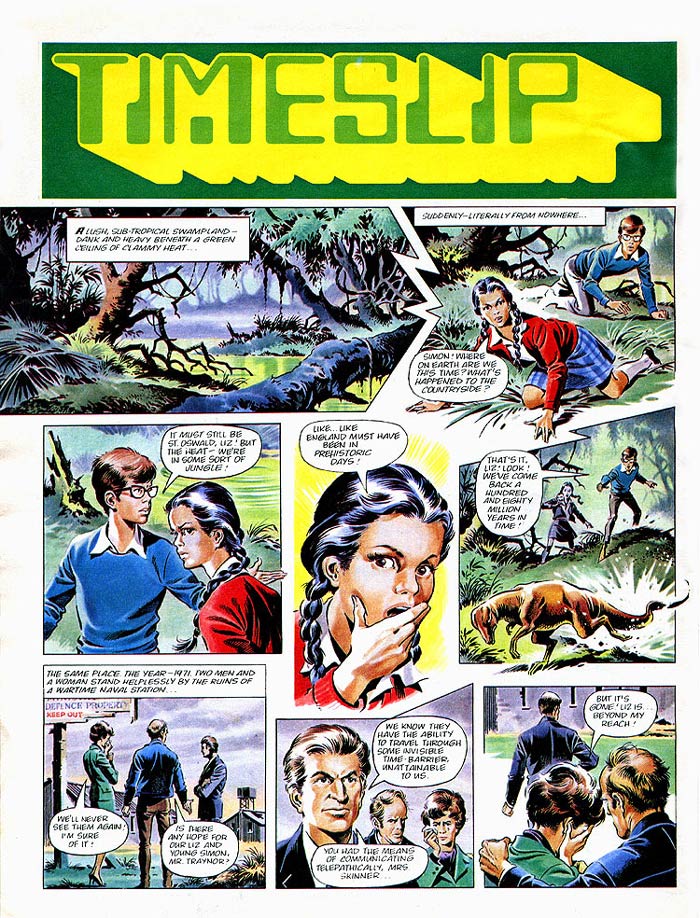
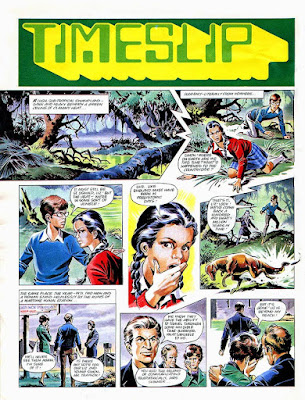
personalities. In the earliest issues the main strip was Timeslip, from the children’s serial about time travel. This was illustrated
by Mike Noble, whose first strip work was drawing Simon and Sally in EAGLE’s companion
paper Robin. Mike later became an
established adventure strip artist, drawing Fireball
XL5 and Captain Scarlet for TV Century 21. Timeslip occupied two
colour pages. Another early adventure
strip was Freewheelers, drawn by Vicente
Alcazar and later Jorge Badia, in black and white. Also in early issues were a
two page black and white strip of Please
Sir! a popular TV comedy series set in a school. This was drawn by Graham
Allen, whose previous work included cartoon strips for several of Odhams’ Power Comics and Typhoon Tracy for Tiger. He would later draw some episodes of the Please Sir! spin off, The Fenn Street Gang. A
historical strip adapted from a serial called Wreckers at Deadeye was drawn by C.L. Doughty who had replaced
Robert Ayton as artist of Jack O’Lantern in
EAGLE.
The
free gift given in the first issue was a press out model of the Magpie TV studio. Magpie was ITV’s answer to BBC’s long running educational
‘magazine’ programme Blue Peter and
originally it was planned to name the magazine after the programme, but having
its own title freed Look-In to
develop its own distinct style. It also outlived Magpie by nearly fourteen years, so the decision was undoubtedly
the right one. The model included press our figures of Magpie’s presenters, one of whom was Susan Stranks, the daughter of
PC 49’s creator, Alan. The early
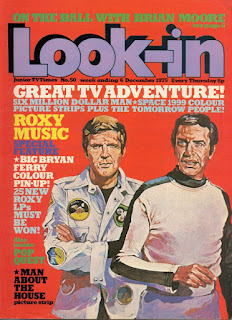
issues carried photo covers, but these were soon replaced by painted ones by
the poster artist Arnaldo Putzu, which made Look-In
instantly recognisable and visually appealing for the buyer seeing it on a
news-stand.

Many ITV programmes only ran for one or two series, so Look-In featured a lot of different
strips during its twenty three year life. Mike Noble worked on the paper until the
mid 1980s and in that time drew The
Famous Five, Follyfoot, Worzel Gummidge, The Adventures of Black Beauty, Space
1999, Kung Fu, The Man from Atlantis and
Robin of Sherwood, among others. Look-In also featured the work of many
other talented artists. These included John Burns, who had illustrated Wrath of the Gods for Boys’ World and EAGLE in the mid sixties and The
Fists of Danny Pike and a Dan Dare adventure
for the new EAGLE in the 1980s. He
drew Magnum, The Bionic Woman, Space 1999, The Tomorrow People, Smuggler and How the West Was Won. Brian Lewis, who
had drawn Mann of Battle, The Guinea Pig and
the humorous strip Blunderbirds for EAGLE, drew a humorous strip based on a
character played by the comedian Les
Dawson. He also drew the adventure strips Freewheelers
and Mark Strong, a strip based on
an action figure. Gerry Embleton, who
drew a few Riders of the Range episodes
in the original EAGLE and the early Dan Dare episodes in the new version,
drew Catweazle for Look-In. Tom Kerr, who drew Oddball Oates in the combined Lion and EAGLE in 1969, drew Crowther in Trouble in early issues and later Doctor in Charge and The Fenn Street Gang.
An
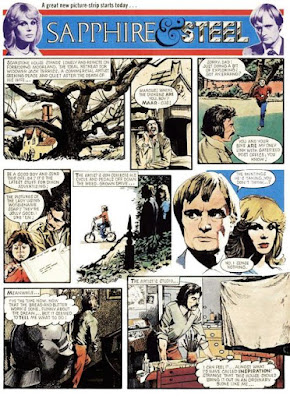
artist who first came to prominence in Look-In
was Arthur Ranson, who drew strips as diverse as the fantasy adventure Sapphire and Steel and the cartoon Dangermouse. He illustrated The ‘A’ Team and a series of
biographical strips about popstars, including The Beatles and ABBA. Artists
on Look-In tended to move around
strips and Ranson also worked on Doctor
in Charge, The Bionic Woman, Buck Rogers in the 25th Century and
Robin of Sherwood. John Bolton also
drew The Bionic Woman and Martin
Asbury also drew Buck Rogers and Kung Fu. Asbury contributed many strips
to Look-In over the years, including Battlestar Galactica, Dick Turpin and The Six Million Dollar Man. Harry North
illustrated On the Buses, Supergran and
ALF (Alien Life Form), Phil Gascoine drew Knight Rider and Robin of
Sherwood and Bill Titcombe, who came to Look-In
after years of experience on TV
Comic, drew Inspector Gadget,
Dogtanian, Scooby Doo and strips based on comedy characters played by
Cannon and Ball and Benny Hill, although the Benny Hill strip was first drawn
by Andy Christine. The Six Million Dollar
Man and The Bionic Woman teamed
up in 1979 in a strip called Bionic
Action, which was drawn by Ian Gibson, Ron Tiner, John Richardson and Mike
White.
Despite
the limited number of strips in each issue, Look-In
managed to include a great many different ones in its run. Other strips I
have not mentioned include Pathfinders,
Voyage to the Bottom of the Sea, Bless This House, Man About the House, Just
William, Mind Your Language, Terrahawks, Charlie’s Angels, The Fall Guy and
Magnum P.I. There was also a
fictional adventure strip about the actor and popstar David Cassidy!
Although
Look-In employed many of the best
strip artists available, most of the stories were written by one man. This was
Angus P. Allan, the son of Carney Allan, who had written Mann of Battle for EAGLE. Angus
had never written for EAGLE, but he
wrote the New English Library’s 1977
novelisation of the very first Dan Dare adventure.
His scripts for the Dangermouse strip
were enjoyed so much by the TV cartoon’s makers that they were adapted for
television and he wrote several new ones for television too. Angus had first
worked with Alan Fennell on TV Century 21
in the mid sixties. Fennell left Look-In
in 1975 and was replaced by art editor Colin Shelbourn. Geoff Cowan, the son
of Edward Cowan the author of many strips for the sixties EAGLE, including Blackbow the
Cheyenne and Cornelius Dimworthy, was
chief sub editor on Look-In and wrote
several comedy strips including the Benny Hill and Leslie Crowther pages. Finally
Scott Goodall, who wrote Manix, Walk or
Die and Invisible Boy for the
1980s EAGLE, wrote On the Buses.
In
September 1972 Look-In introduced a
four page ‘Pop Pullout’ and subsequently much more emphasis was placed on
popstars, particularly those who appealed to young teenage girls. This proved
popular with its target audience and kept sales high, but was less appreciated
by the male readership, as evidenced by comments from its former and now adult
readers, such as comic artist Lew Stringer, who wrote an interesting Comics Blog called
Blimey! for several years. He wrote “Look-In had always been aimed at both
sexes but now it felt like it was turning into Jackie.” Comics enthusiast Norman Boyd replied on Lew’s blog: “I
too had the first couple of years and gradually got cheesed off with the Donny
Osmond type stuff.” However the strip content was maintained and despite losing
some male readers, it clearly gained some female ones.
Over
the years, Look-In included some
excellent informative features which would not have been out of place in EAGLE. A good example is Survival, which took its name from a television show that explored
wildlife under threat. There were also science articles, written by Peter
Fairlie, who was the Science editor for Independent Television News. World of Sport and On the Ball, named after the ITV sports programmes, featured
articles by Brian Moore, the ITV sports commentator and various sports
personalities. The disc jockey and children’s TV presenter, Ed Stewart wrote a
regular page for the magazine from the first issue until 1980. This took
several forms, including a news page and articles about his work in radio. How? was named after the TV show which
explained in clear terms how things work and the magician David Nixon showed
readers how to perform simple tricks.
Like
Fennell’s earlier weekly, TV Century 21, Look-In
was undoubtedly influenced by the early EAGLE.
On TV Century 21 he had engaged
some of EAGLE’s best former artists
to produce a high quality weekly of EAGLE’s
size, with eight pages in colour and printed in photogravure by Eric
Bemrose, EAGLE’s printer. The front page was presented as a future
newspaper, using an idea which had also originated in EAGLE, on the Dan Dare strip.
In Look-In, high quality printing was first provided by Southernprint of Poole in Dorset and later by Carlisle Web Offset. Fennell also included a lot of well
written educational and informative features, along with high quality strips
and he wrote signed editorials to his readers, just as EAGLE’s Marcus Morris and Clifford Makins had done.
I
believe that in its turn Look-In influenced
the 1980s EAGLE. In his book Comic Strip Hero, Barrie Tomlinson, the
new EAGLE’s originator and group
editor, wrote that one of the aspects of the old EAGLE that he was keen to include in the new version was the
involvement of well know personalities to write for the weekly. While some
famous people had made contributions to the original EAGLE, notably on the sports
pages, the involvement of personalities was much greater in Look- In. Barrie Tomlinson recruited the
disc jockey and children’s TV presenter Mike Read to write for EAGLE, just as Look-In had employed Ed Stewart. He also praised the way that the
original EAGLE engaged with readers
through the Editor’s letter and clubs, competitions and offers. Accepting that
the first EAGLE was his inspiration,
he must have been greatly encouraged to say the least by the fact that a
contemporary magazine whose editor also engaged with the readership and
provided a blend of strips, features and competitions had proved such a
success.
Look-In was a
major success at a time when comics sales were in steady decline. Launched
twenty months after the original EAGLE was
absorbed into Lion, it continued for
the next twelve years when there was no EAGLE
and then lasted throughout the life of the new EAGLE, outliving it by two months. None of the I.P.C. comics which
already existed when Look-In was
launched were still running when it closed. Sales were undoubtedly stimulated
by its strong links to television, but there were several other weeklies
devoted to television over the years and only TV Comic, which began at a much healthier time for comics (in 1951)
ran for longer, but it folded a decade before Look-In.
Clear
indications of Look-In’s quality are
the three Facebook groups devoted to the
magazine, the two books published about it and the prices it sells for on
Amazon and e-bay. Like EAGLE it is
fondly remembered.


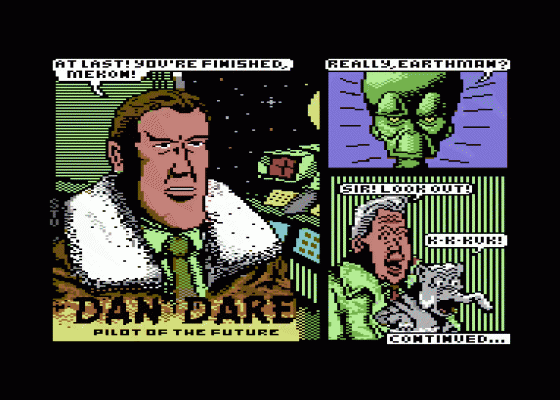
 Another song entitled Dan Dare was recorded by the Punk Rock group The Mekons in 1978 and featured on their debut album The Quality of Mercy is Not Strnen (not a misprint!). As the group's name indicates, they were fans of Dan Dare. Although they have undergone significant changes in personnel and musical styles over the years and ceased activity for a while, they still perform to this day, with their latest album being released in 2020.