WELCOME

Welcome to the web home of THE EAGLE SOCIETY.

THE EAGLE SOCIETY is dedicated to the memory of EAGLE - Britain's National Picture Strip Weekly - the leading Boy's magazine of the 1950s and 1960s. We publish an A4, quarterly journal - the Eagle Times.

This weblog has been created to provide an additional, more immediate, forum for news and commentary about the society and EAGLE-related issues. Want to know more? See First Post and Eagle - How it began.

Wednesday, 3 December 2025

THE FOURTH CHRISTMAS EAGLE by John Culshaw


Another Christmas and another planet for Dan Dare and Digby. The fourth Christmas issue of EAGLE  was dated 24th December 1953 (Vol. 4 No.38) and Dan was now on Titan, one of Saturn's moons, investigating the source of missiles that were being fired at Earth. Despite being a continuing story, the strip managed to acknowledge Christmas in a big way as Digby explained the significance of the feast to a young Saturnian boy, while the strip showed images of Spacefleet personnel celebrating back on Earth.  

The EAGLE logo has a special Christmas design, with the usual white letters coloured yellow and decorated with snow. The red block title box includes several sparkling stars and the top left hand corner of the page features bells and holly, while the top right hand corner features holly. Across the top of the page is the greeting 'Happy Christmas to EAGLE readers'.  The 'Dan Dare' adventure continues on page two with Spacefleet staff on Earth drinking to 'absent friends', referring to Dan and his crew and the story picks up from there, with Dan continuing his adventure on Titan. The art on the 'Dan Dare' strip is by Desmond Walduck. At this point in the story the writer was Basil Dawson, who was credited in just one episode and under the nom de plume of 'Don Riley'. Dawson, who wrote many radio and television adventure stories, including some Dick Barton - Special Agent serials took over the writing when Dan's creator Frank Hampson fell ill. Dawson would write the novel Dan Dare On Mars in 1956.   

Page three is occupied by the final episode of the 'PC 49' adventure 'The Case of the Magnificent Mouse' and Christmas is celebrated at the end of the episode where 49 and his Boys' Club celebrate the end of the adventure at their Christmas party. The strip was written by Alan Stranks and drawn by John Worsley.  The next page and a quarter are occupied by an article by EAGLE's 'Special Investigator' Macdonald Hastings and his piece has a definite Christmas theme, for it is about reindeer. Hastings visited a Laplander living near Aviemore in Scotland, who owned a herd of reindeer he had brought from Lapland to see if they would thrive in Scotland. It is clear from the article that there were very few reindeer in Britain in 1953 and indeed it is implied that this herd were the only ones. There are significantly more now.  The lower quarter of page four is an advertisement for Calvert's 'Dan Dare' Toothpowder, with all the focus being on the free 'Dan Dare' picture cards with each carton and the free 'Dan Dare' picture card album that can be obtained by sending the empty carton back to the manufacturers. This advert is a clear reminder of how popular Dan Dare was in the 1950s. Page five also contains a few Christmas tricks and puzzles from Richard Murdoch, which occupies the top right hand corner of the page. Murdoch was a popular radio and film comedy actor, who made regular short contributions, such as jokes and puzzles to EAGLE at this time. The bottom half of page four is split between two advertisements. One is for Sharp's Toffee. No problems there. The other is baffling. It is for something called 'The Free Enterprise Campaign' and the advert is fronted by Donald Peers, who was a popular singer at the time. Basically it encourages readers to work hard because where there's free enterprise there's opportunity. It might be Government sponsored, but it seems to be aimed more at adults in the workplace than children and teenagers, although many young people did start work at fourteen in the early fifties. I have reprinted it here. See what you make of it.    

The top half of page five is the Sports section and features short articles by EAGLE's regular sports contributors on their 'Thrill of the Year'. The cricket writer Patsy Hendren wrote about a County match that resulted in a rare dead heat. Geoff Paish wrote about a Wimbledon tennis marathon game. R.M. Samuel wrote about Norman Parker's final speedway ride and James Audsley wrote about an endurance run from Bath to London. Christmas was referenced in a simple greeting to readers below the articles. The bottom half of the page featured the comedy strip 'Professor Puff and His Dog Wuff' and in this episode the Professor helps Father Christmas to deliver presents. The strip was by David Langdon. 

Page seven was the colour 'Riders of the Range' page and marked the first episode of a new serial 'Jeff Arnold and the Arizona Kid.' For once, Christmas is also included in the strip as Jeff and Luke enter a saloon on Christmas Eve and it is decorated with banners and paper chains. The strip was written by Charles Chilton as usual and was illustrated by Frank Humphris, who was now the regular artist and would remain so till it ended more than eight years later. 

On the top half of page eight and nine is the weekly cutaway drawing and as in every Christmas issue it has a festive theme. A series of labelled pictures, including some with cutaways show how Christmas telegram greetings were sent round the world. The drawings were by Leslie Ashwell Wood who was the principal cutaway artist throughout EAGLE's nineteen year run. The bottom half of the page marked the start of a new 'Luck of the Legion' adventure 'The Secret City'. Set in Indo-China, there is no mention of Christmas as the story gets off to an exciting start as Sergeant Luck leads a patrol back to the Legion Post to find that it is under attack. Geoffrey Bond wrote the strip, which was illustrated by Martin Aitchison, who drew every single episode of every 'Luck of the Legion' adventure, from its start in 1952 to its end in 1961.

Page ten is also divided into two parts. The top half is a strip in the series 'Great Escapes' and is about King Charles II's escape from the Parliamentarians during the Civil War. It was written by Guy Morgan, who also wrote EAGLE's 'Storm Nelson' strip as Edward Trice and drawn by Pat Nevin. It does not concern Christmas. However, the lower half of the page is an episode in the series 'These Men Live Dangerously', which features coal miners in this issue and does mention Christmas as it reminds readers that without coal there would be no cosy fire at Christmas or power to cook the turkey and Christmas pudding. A large frame in the strip shows a family opening their Christmas presents round the fire. This strip was drawn by Dudley Pout. 

Page eleven is the Editor's page and in the top left hand corner is his letter to readers. Marcus Morris wrote about Christmas being a time for family gatherings, but acknowledged and greeted the readers who were in hospital or orphanages. In 1953 there were many orphanages. He reminded readers that Christmas marks Jesus' birth and involves giving as well as receiving. To the right of his letter is a Christmas competition with a prize of a bicycle and Christmas greetings from Frank Hampson, Michael Gibson the Art editor. Ellen Vincent the assistant editor and Morris himself. Small photographs of the four accompany the greeting. Below Morris' letter are four 'Readers' Letters'. Three do not relate to Christmas, but one from Alfred Robinson of Ilford suggested using the recent 'Whodunnit' series as competitions at parties. Morris thought this was an excellent idea and suggested using the 'What's His Name?' strip as well. Alongside the readers' letters is a poem 'Christmas Thoughts for a Boy', which was not credited, but was probably written by a staff member. It is strongly religious, commenting on Christ's crucifixion as well as his birth. This page makes EAGLE's Christian philosophy clear and emphasises the religious significance of Christmas. The bottom of the page features the weekly three picture 'Chicko' strip by Norman Thelwell and EAGLE Club News, which offers gifts to club members whose birthdays fall on six specific dates from across the year listed above the text. As usual 'Chicko' has a Christmas theme.  
 
Page twelve features a text serial about 'The Three 'J's'. This school based series began in January 1953 and would run until April 1959.  It was written by Peter Ling, who would go on to create the TV soap operas Compact and Crossroads with Hazel Adair and write the Doctor Who serial 'The Mind Robber'.  While this story was set in the Christmas holidays, the episode focuses on a school football match and Christmas is not otherwise featured. The 'drop in' illustrations are by Dudley Pout. In the bottom right hand corner of this page is an 'EAGLE Window' which suggests various EAGLE related products that readers might like to buy if they have been given money for Christmas. In the issues leading up to Christmas, EAGLE heavily advertised potential presents by carrying a weekly four page advertising section, including many directly related to its own characters, particularly 'Dan Dare' and 'Riders of the Range'. However, the Christmas issue itself was too late for boys asking relatives for presents, which enabled EAGLE to focus on the 'giving' aspect of the feast, without being swamped by the 'receiving', highlighted by the advertising. 

Page thirteen contains a half page 'Harris Tweed, Extra Special Agent' comedy strip by John Ryan, which is set on Christmas Day. The mean spirited Tweed has not bought a turkey as he will be dining with Lord Snoot later, meaning that 'the boy' must go without. The opening frame shows the pair eating boiled eggs. But as usual, matters end in the boy's favour as he wins a lavish Christmas dinner which he shares with his friends, while Tweed has to act as waiter. The full page 'Tweed' stories ended in 1953, but the strip continued as a half page until 1962, when it ended. This was certainly a loss for EAGLE as the full page stories had been exciting and funny. While the half page included many serial stories, it was never as good. There was usually only room for one joke. By now, John Ryan was also producing a half page 'Lettice' strip for Girl, EAGLE's companion weekly and the demands of producing a whole page comedy  adventure with five lines of detailed drawings were considerable. The bottom half of page thirteen contained adverts for Cadbury's Chocolate, Blue Bird Toffees and Odol solid toothpaste. EAGLE had no qualms about advertising rival products in the same issue! The Odol adverts included brief true stories about stamps and free foreign and colonial stamps were given away with each tin. This would clearly attract stamp collectors, but would most EAGLE readers be more attracted to the 'Dan Dare' picture cards being given away by Calvert's Tooth Powder, advertised a few pages earlier?     

On page fourteen 'Storm Nelson - Sea Adventurer' continued his first adventure, which had begun in October. This strip was written by Guy Morgan (as Edward Trice) and drawn by Richard Jennings. Morgan was a successful screenwriter, whose credits then included The Captive Heart, based on his own novel and Albert R.N. Both these films were about prisoners of war and Morgan himself had been a prisoner of the Germans in the Second World War.  Albert R.N. was actually based on the experiences of the 'PC 49' artist John Worsley, who as a prisoner of war actually made the 'Albert' dummy to fool his German captors. Storm Nelson owned a large yacht, a helicopter and a submarine which he utilised in the cause of justice. With the story being halfway through, there was no reference to Christmas in the strip itself, but there is a Christmas greeting alongside the strip's title.

Page fifteen usually housed the 'Tommy Walls' serials, sponsored by Wall's Ice Cream, but in this issue, which was between adventures, Tommy presented a 'Christmas Page', with games and puzzles to use at parties. The illustrations here are by Richard Jennings, who was the regular artist on 'Tommy Walls' before taking on 'Storm Nelson'.

The final page (sixteen) features the latest episode of 'Alfred the Great', a serial about the life of the famous Saxon King. Written by Chad Varah and illustrated by Norman Williams, it does not reference Christmas. In previous years, the back page biographies had always managed to contrive a reference to the occasion, but this serial was well into Alfred's story and a Christmas reference would not have fitted. The issue acknowledged the feast in so many other ways, that there was no need to mention it here.    


Tuesday, 2 December 2025

IN AND OUT OF THE EAGLE 57

In 1964, EAGLE's publishers Odhams Press launched a new weekly called Wham! mainly created by the cartoonist Leo Baxendale, who had created 'The Bash Street Kids', 'Little Plum' and 'Minnie the Minx' for D.C. Thomson's Beano comic. Among the new characters he created for the new comic was 'Danny Dare', a boy who was 'Dan Dare's Number One Fan'. In this comedy strip, whenever Danny got into trouble, he would imagine what Dan Dare would do in a similar situation. Leo wrote and drew just three episodes of the strip (in Issues one, four and eight) as he could not produce almost an entire comic single handed every week and Artie Jackson became the regular artist, with Walter Thorburn taking over later. However, the strip included daydream scenes featuring Dan Dare and these were usually drawn in the 'adventure strip' style of Dan's adventures in EAGLE by Bruce Cornwell or Don Harley, who had worked on 'Dan Dare'. Keith Watson was the current artist on 'Dan Dare' at this time, but the demands of that strip kept him too busy to contribute to 'Danny Dare' as well. Towards the end of 'Danny Dare's' run, Jackson or Thorburn would also draw the 'adventure frames'. The strip ran until the final issue of Wham! which was Issue 187, although it did not appear in every issue and sometimes was just half a page. It regularly encouraged readers to read Dan Dare's adventures in EAGLE throughout its run and 'Danny' was occasionally promoted in EAGLE.  


Tuesday, 25 November 2025

DAN DARE'S SPECIAL PROJECT - A fabulous new informative resource from Italian enthusiasts!


The Italian Fumettomania Factory Association who are enthusiasts of British comics are completing a “Special Project” devoted to the ‘Dan Dare’ strip. The Project includes a series of articles covering all aspects of ‘Dan Dare’ from his creation in 1950 right up to the present day. They can be accessed online and are available in both Italian and English. John Freeman’s ‘Down the Tubes’ site and the EAGLE Society have assisted with this significant project, which includes articles by both Italian and British contributors. There is also a collection of videos from over the years relating to ‘Dan Dare’, including episodes from the 2002 CGI television series. The ‘Special Project’ is edited by Mario Benenati and Daniele Tomasi. 

https://www.fumettomaniafactory.net/special-project-dan.../


Monday, 24 November 2025

DAN DARE MIGHT BE BACK!


B7 Comics has teamed up with bestselling author and screenwriter Alex de Campi (Rogue Trooper: Ghost Patrol and Duncan Jones’ Madi: Once Upon a Time in the Future) and artist Marc Laming (James BondEdenEndeavour) for a three-book reimagining of Dan Dare’s adventures with the approval of the rights holders The Dan Dare Corporation.

“A dying planet, a desperate mission – and a first contact that may spell the end of human life as we know it…” sets the scene for these all-new Dan Dare comic book adventures. Dan Dare: First Contact is being planned as a 112-page, graphic novel which will be offered as an eBook, paperback, hardback and premium Kickstarter-exclusive hardback edition. 

“Alex and I are huge fans of Dan Dare from Frank Hampson and Frank Bellamy’s original stories of the 1950s and 60s, through to 2000AD’s more anarchic take on the character in late 70s. We are both extremely excited to bring Colonel Dare to a new audience,” says Marc Laming


“I think our tale has something for fans of the original Eagle stories and for lovers of modern sci fi action of the screen and books.”


Writer Alex de Campi adds; “It’s truly been an honour to be given the opportunity to bring Dan Dare to a whole new generation, making the story feel exciting and modern without losing any of the charm and wonder that has kept it a beloved classic for so long.”


The realisation of this new version depends on a crowdfunding campaign, which will launch on February 1st 2026. If this is successful, Dan Dare: First Contact will be published in 2027. The script for the first book has already been written and Marc Laming has drawn some concept art.


Saturday, 25 October 2025

IN AND OUT OF THE EAGLE 56


One of the many 'Dan Dare' products produced during the 1950s was the Wallis Rigby 'Anastasia' Presso Book. This provided press out cardboard parts which made up into a model of Dan's spaceship, named in honour of Digby's Aunt Anastasia, who was instrumental in preventing the Treens from conquering Earth. Brian Hayes, an EAGLE Society Member and collector recently acquired a copy of this book and has made up the model as shown below. Brian placed a Kentoys 'Dan Dare' figure for scale.  
Normally when these books become available, collectors are reluctant to spoil the book by making the model, but Brian found a poor quality book with browned and brittle text pages, but perfect metallic model pages, so he was happy to make up the model.  


Saturday, 18 October 2025

IN AND OUT OF THE EAGLE 55

This is the front page of D.C. Thomson's Hotspur story paper dated August 23rd 1947 and the 'eagle' picture is notably similar to our own EAGLE symbol which adorned the weekly from Issue One in April 1950. Our own symbol was created by Frank Hampson and was based on an 'eagle' shaped inkwell on Marcus Morris' desk. The choice of the name EAGLE for the weekly was inspired by the 'eagle' lectern in Morris' parish church, St. James' in Birkdale, Southport. 

The Hotspur was launched in 1933 as a weekly for boys, which contained text stories, not comic strips. It was the last of D.C. Thomson's 'big five' boys' story papers, after Adventure (1921), Rover (1922), Wizard (1922) and Skipper (1930) to be launched The first issue sold over 350,000 copies and my father bought one, which I still have. During the Second World War it became a fortnightly publication due to paper rationing, increasing to three issues a month in 1946 and back to a weekly in 1949. It ran for 1,997 issues until October 1959, when it was relaunched as a comic strip paper and initially retitled The New Hotspur. It then ran for another 1,110 issues until it merged with Victor in January 1981. 

Like many boys' papers, The Hotspur stories and later strips covered school, sports, detective, war, spy, science fiction and historical adventure stories. 
 

Tuesday, 7 October 2025

EAGLE TIMES Vol. 38 No. 3 Autumn 2025

The new EAGLE Times is out now. In this issue are articles about Willie Patterson, Ron Embleton and John Burns' strip 'Wrath of the Gods', which joined EAGLE when it absorbed Boys' World; Luis Bermejo's work on 'Heros the Spartan', and the second part of the back page strip about Winston Churchill 'The Happy Warrior'. There is also the latest part of David Britton's 'Me Too' series about female artists of the 1950s, which looks at the art of Daphne Bevis Rowles, whose work included the 'Nicky Nobody' strip for Swift. The issue also includes two more 'In and Out of the EAGLE' pages by Jim Duckett, the first part of a new Archie Willoughby story 'The Case of the Brand New Hat', a page looking at some of the readers' letters that appeared in EAGLE and four pages of our own readers' letters. Copies can be obtained from Bob Corn at the address on the right. 

Saturday, 26 July 2025

IN AND OUT OF THE EAGLE 54

Although there were EAGLE Annuals every year, several character annuals and several novels about EAGLE characters, 1954 brought a unique book. This was a 'Riders of the Range' strip book, Jeff Arnold and the Bozeman Trail which today would be called a graphic novel. Written by the strip's creator and regular writer Charles Chilton and illustrated by Pat Williams, the book featured the war with the Sioux and Cheyenne in the 1870s and the Battle of the Little Bighorn. It was published by Juvenile Publications, who also published the early Riders of the Range Annuals. Just three and a half years later, the same events would be covered in the weekly EAGLE in the 'Riders' serial 'The War with the Sioux', but there were significant differences between the two stories. The later version was much longer than the strip book and featured many more historical characters and exciting action. The biggest difference was Jeff Arnold's involvement in the battle itself. In The Bozeman Trail , Jeff was not with Colonel Custer's group who were massacred, but with Major Reno's group, who were forced to take up a defensive position away from the fight with Custer and survived. In 'The War with the Sioux', he was with Custer to the end and escaped the massacre by being knocked unconscious and saved from death by Running Bear, a Sioux warrior who he had beaten in single combat some months earlier and spared his life. While these events were more exciting for readers, the Bozeman version is more credible. Both versions contain historical inaccuracies, but both are more accurate than Hollywood film versions of the events. The weekly serial was illustrated by Frank Humphris, who researched and captured accurate likenesses of General Crook, Major Reno, Custer, Sitting Bull and others. In a previous post on this blog, Steve Winders wrote about the different studies that Humphris illustrated in different media of the battle, after he visited the battlefield and saw an original painting of it by Humphris, in the Trading Post next to the site. David Britton also examined the weekly strip in his detailed series for EAGLE Times. 
Despite the differences, Charles Chilton wrote both versions of the story. Pat Williams' artwork is much more stylised than Humphris' and some of his backgrounds are sketchy. While he produced accurate likenesses of General Crook and Custer and a reasonable likeness of Sitting Bull, other historical characters were not accurately portrayed. His work is nevertheless appealing. He captured movement well in many frames and he created vivid images which captured the epic scale of the events in his large frames. The book is entirely in colour and contains several full page and double page images. Juvenile Publications also produced another strip book, illustrated by Williams the same year. This was not EAGLE related, but an adaptation of the 'Biggles' novel, Biggles and the Cruise of the Condor. 
Below is a frame by Williams from The Bozeman Trail, showing the Sioux and Cheyenne attack on Custer's Seventh Cavalry. It is taken from the original artwork.


(The owner of this artwork is willing to sell it for an offer in the region of £400. He also has the original of the wrap around front cover which he is willing to sell for around £600. If you are interested then message me on Facebook or in the comments section here and I will put you in touch with him.) 


Tuesday, 1 July 2025

EAGLE TIMES Vol. 38 No.2 SUMMER 2025


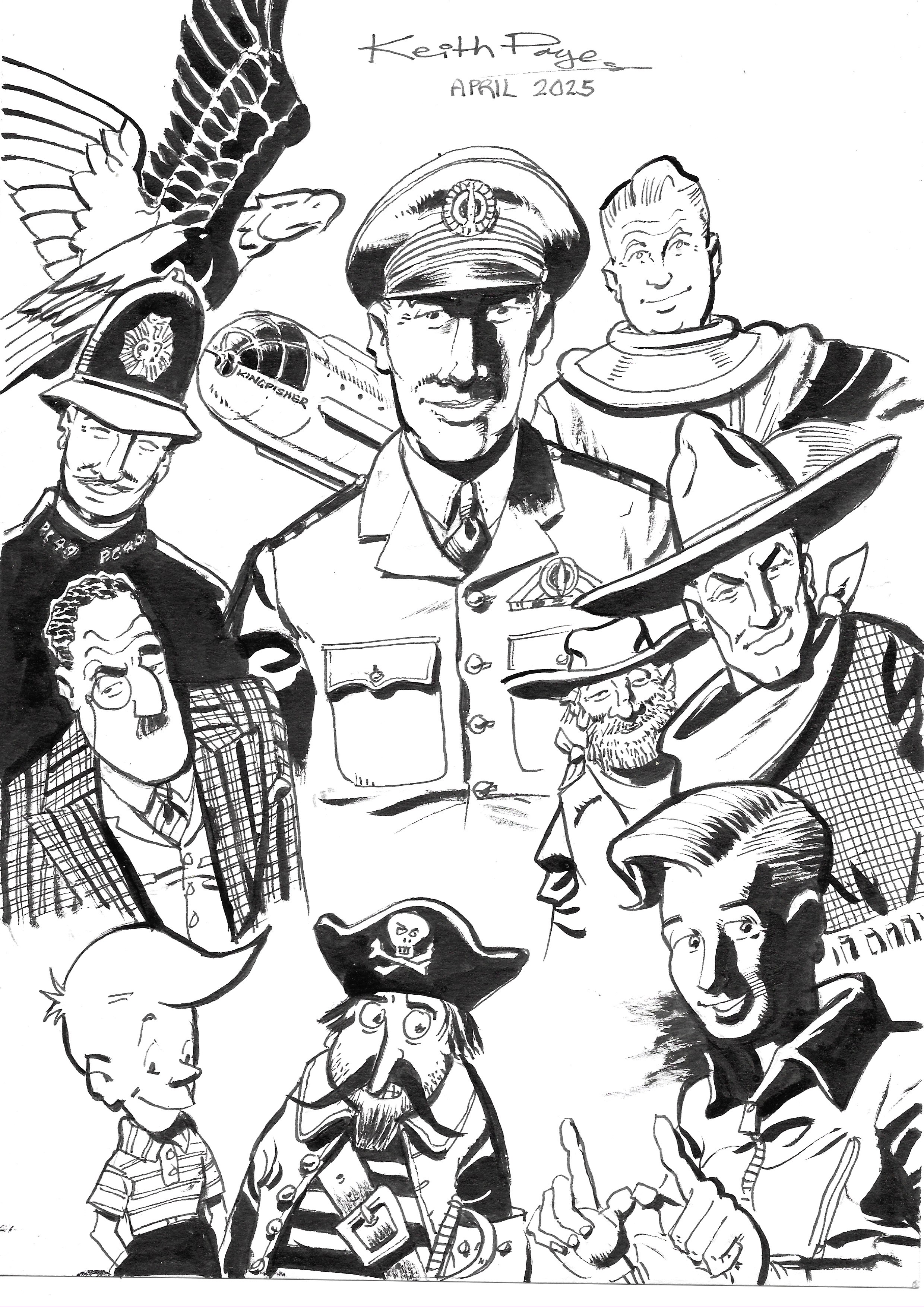
The 150th edition of EAGLE Times is out now. Featuring a cover by Graham Bleathman showing Dan Dare's spacecraft 'Anastasia' and several other craft flying over a future London and the back page with black and white studies of EAGLE characters by Keith Page, it celebrates the occasion in style. The contents include articles about 'Jack O' Lantern' and his creator George Beardmore, by Eric Summers; 'Blackbow the Cheyenne' by David Britton and 'Montgomery of Alamein' by myself. Reg Hoare's report on our  recent Gathering in Plymouth and my own speech about EAGLE and the radio from the Annual Dinner are also featured, along with the final part of the latest Archie Willoughby story 'The Case of the Elusive Elvis'. Copies can be obtained from Bob Corn at Mayfield Lodge, Llanbadoc, Usk, Monmouthshire, NP15 1SY.  


Sunday, 15 June 2025

IN AND OUT OF THE EAGLE 53


From its first issue, dated 26th January 1963 until its last, dated 3rd October 1964, EAGLE's companion paper Boys' World ran a full colour strip based on Greek Mythology called 'Wrath of the Gods'. Illustrated first by Ron Embleton and later by John M. Burns and written by Willie Patterson, it joined EAGLE when the two papers were hurriedly combined and it ran for six more issues, until the current serial story was completed in the issue dated 14th November. There were four 'Wrath of the Gods' serials in total. The hero was a young Greek called Arion, who was sent on perilous quests by the gods and faced gods and monsters in his adventures. The first, third and fourth adventures occupied the middle page spread and the second occupied the back page. 
The Book Palace have recently produced a high quality reprint album which includes all the 'Wrath of the Gods' serials and the science fiction strip 'Ghost World', also from Boys' World. This single page weekly serial was illustrated by Frank Bellamy and written by the celebrated science fiction novelist Harry Harrison. The album is available in two versions - a De-luxe hardback Collectors' Limited Edition of 450 copies, retailing at £75 and a Super De-Luxe Collectors' Limited Edition of 50 copies, retailing at £130, which is enclosed in a hardback clamshell case and also includes a sixteen page booklet, which reprints the three 'Wrath of the Gods' strips from Boys' World annuals as well as prints scanned from original artwork by both Burns and Bellamy. These include a print of an original unpublished pencil sketch of Arion by Burns. The high prices reflect the high quality of the books, which reproduce all the double page spreads as fold outs, to avoid the problems caused by the guttering between pages which invariably result in a loss of art from the middle of the spread in other reprint books. The reproduction quality of the pages is excellent. The books are available from: 

https://bookpalace.com/info_ghostwrath

https://bookpalace.com/info_ghostwrathclam


Sunday, 4 May 2025

EAGLE TIMES Vol. 38 No. 1 SPRING 2025

The latest edition of EAGLE Times is out now. It has a strong Frank Bellamy theme, with the first parts of articles by myself on both 'The Happy Warrior', about Winston Churchill and 'Montgomery of Alamein' about the famous wartime General. Both strips were illustrated by Bellamy and written by Clifford Makins. The issue also includes articles by David Britton about 'Blackbow the Cheyenne', 'Riders of the Range' and the artist June Mendoza, Peter Barr's latest piece on 'EAGLE's Sporting Heroes', two of Jim Duckett's 'In and Out of the EAGLE'  pieces and the first part of a new Archie Willoughby story by myself. With a cover by Carol Tarrant, the issue can be obtained from Bob Corn at the address alongside. As the first issue of the year, this is a good time to subscribe for four issues and to join the Society.   


Wednesday, 30 April 2025

EAGLE SOCIETY GATHERING AT PLYMOUTH

The EAGLE Society celebrated the seventy fifth anniversary of EAGLE in Plymouth this week. Our guests were Ray O'Donnell from the Devonport Naval Heritage Centre, who spoke about the Devonport Naval Dockyard and the artist Alan Langford, who contributed to the 1980s EAGLE2000 A.D. Warlord and Supernaturals and has provided cover art and illustrations for many fantasy game books. Now specialising in equestrian subjects, he has recently returned to comics, producing a graphic novel The Secret of the Aesir, which combines science fiction with Norse mythology. He demonstrated the techniques he uses by producing an inked illustration of Conan the Barbarian mounted on a horse. Our member Eric Summers gave a talk on the EAGLE character, 'Jack O'Lantern' and I gave talks on the Eddystone Lighthouse and radio shows of the 1950s and 60s. A group of us visited the Royal Citadel overlooking Plymouth and the sea and another group took a cruise around the harbour and the River Tamar. We were blessed with warm sunny weather and well served at the New Continental Hotel. Our anniversary cake was supplied by the 'Cake Box' in Plymouth. Thanks to Keith Page, who was sadly unable to attend but sent a piece of original artwork featuring the main EAGLE characters from its first year, which was auctioned for EAGLE Society funds and will be featured in our second issue this year.  
A full account of the Plymouth Gathering by Reg Hoare will also appear in our second issue of EAGLE Times.  


Friday, 4 April 2025

HAPPY BIRTHDAY EAGLE - SEVENTY FIVE YEARS OLD

It is now seventy five years since EAGLE was launched, on April 14th 1950. A huge success for its first decade, it ran until 1969, when it was absorbed by its rival paper Lion. Created by the Rev. Marcus Morris, a Southport Vicar, its early success was primarily due to the work of artist Frank Hampson and his creation 'Dan Dare Pilot of the Future'. The popularity of Dan Dare cannot be overstated. The strip made science fiction acceptable and respectable at a time when many older people dismissed it as ridiculous and EAGLE was read by a lot of older people as well as its principal audience of 7 - 16 year olds. It also promoted interest in outer space and the possibility and credibility of space travel. Stephen Hawking cited 'Dan Dare' as the reason he became a Cosmologist. EAGLE also made comics acceptable to many adults, although it would never admit to being a comic! The fact that the editor was a Vicar and that EAGLE promoted a 'muscular Christianity' in its pages brought parents and teachers onside. The early issues of EAGLE also included the popular radio character 'PC 49', written by Alan Stranks. Initially drawn by Strom Gould it was illustrated for most of its seven year run by John Worsley. There were three other strips by Hampson in the first issue: 'Rob Conway', 'Tommy Walls', an advertising strip for Walls Ice Cream and the life of St. Paul, but he quickly passed these on to other hands to enable him to focus on the runaway success of 'Dan Dare'. 'Captain Pugwash' by John Ryan also made his first ever appearance in the first EAGLE. The centre pages featured 'cutaway drawings' of aircraft, cars, ships and other technological marvels. The most prolific 'cutaway' artist was Leslie Ashwell Wood. The 'cutaways' would run for the entire life of  EAGLE and Ashwell Wood illustrated the first and the last. The early issues also included an informative science strip called 'Professor Brittain Explains' and a regular sports page, which featured contributions from well known sportsmen. Over the next few years, other popular strips joined 'Dan Dare'. 'Riders of the Range' was by Charles Chilton and was based on his radio series about cowboys in the American west, This strip began in the Christmas issue in 1950 and was originally illustrated by Jack Daniel and then by Angus Scott, before Frank Humphris took over in 1952. The strip ran until 1962. 'Luck of the Legion' (1952 - 61) was written by Geoffrey Bond and illustrated by Martin Aitchison, 'Jack O' Lantern' (1955 - 59) told the adventures of a boy in the early nineteenth century and was written by George Beardmore, with illustrations by Robert Ayton. 'Storm Nelson - Sea Adventurer' (1953 - 1962) was written by Guy Morgan and drawn by Richard Jennings and 'Harris Tweed Extra Special Agent' (1950 - 62) by John Ryan, replaced his 'Captain Pugwash' who went on to greater success in books and on television. Another comedy strip was the three frame weekly 'short' 'Chicko' (1950 - 62) by Norman Thelwell. The famous Belgian cartoon hero Tintin also made his first ever appearance in English in EAGLE (1951 - 52)The back featured biographies of saints and famous Britons, including Saint Patrick, Saint Louis of France, Alfred the Great, Lord Nelson, David Livingstone and Baden Powell, illustrated by Norman Williams. Many of these biographies were written by the Rev. Chad Varah, who founded the Samaritans. Later, Frank Bellamy illustrated the life of Winston Churchill and King David for the back page, before taking over the 'Dan Dare' strip for a year and subsequently drawing 'Fraser of Africa' (1960 - 61), the life of Field Marshal Montgomery (1962) and finally the celebrated 'Heros the Spartan' strip in the early 1960s. In 1960 - 61, Frank Hampson illustrated the story of Christ for the back page. Sadly, this was his last major work for EAGLE.  

EAGLE featured more than strip cartoons. It had its own 'Special Investigator', Macdonald Hastings, who wrote articles on a wide range of subjects and even performed several dangerous feats to amuse the readers. George Cansdale wrote many half page strips about wildlife and Anthony Buckeridge created Rex Milligan's prose adventures for EAGLE, which would later serialise some of his 'Jennings' stories. Peter Ling wrote school based stories about 'The Three 'J's' before creating Crossroads and writing a Doctor Who adventure for television. EAGLE engaged well with readers. It featured reader's letters and organised competitions. Douglas Adams' first published work was a poem he sent to EAGLE and Gerald Scarfe and David Hockney won prizes in an art competition. EAGLE encouraged acts of charity, selflessness and consideration for others with monthly awards for nominated readers. It ran its own club for readers, arranged trips to sports matches, Adventure Holidays with the Y.H.A. and an annual national Table Tennis competition, along with its companion weekly 'Girl'. Each year readers voted for their 'Sportsman of the Year'. Every Christmas EAGLE invited readers to Carol Services, held around the country and usually led by Marcus Morris. It produced many books on a range of interests in addition to its annuals and even published novels about several of its characters. Its popularity gave rise to a great deal of licensed merchandise with everything from toys to clothing based on its most popular heroes. It even had its own weekly radio programme. There was also a daily Dan Dare radio serial, which ran for five years on Radio Luxembourg. In the 1950s it was not so much a comic, more a way of life. 


EAGLE fell into decline in the 1960s. Its steady downfall was primarily due to changes of publisher and cuts to its budget. It dropped all its reader activities, except the 'Readers' Letters' page and the Y.H.A. Holidays. Marcus Morris left in 1959 and his successor Clifford Makins left in 1961. A new editor, Bob Bartholomew arrived in late 1962 and managed to make improvements, but the downhill slide in sales was impossible to stop. Nevertheless, there were still shining moments. In addition to 'Heros the Spartan' (1962 - 1966), which was written by Tom Tully, there was 'Blackbow the Cheyenne', written by Edward Cowan and drawn by Frank Humphris, which joined EAGLE when it absorbed Swift in 1963 and ran until 1969. There was also 'The Iron Man' by Ken Mennell and others, which joined in 1964 when Boys' World was absorbed and ran until 1969. It was illustrated by Martin Salvador and later by Miguel Quesada. 'The Guinea Pig', (1965 - 1969) was written by various hands and drawn by Colin Andrew, Brian Lewis and finally by Gerald Haylock.  'Dan Dare' continued with stories by David Motton and art by Keith Watson. The 1960s EAGLE also featured some new informative features, including 'The Futurescope' which began in 1967 and speculated about life in the future. It was written by Dr. Lyall Watson, who would later write the bestselling book Supernature.  

 Despite its decline and fall, EAGLE made such a strong impression that a new version was launched in 1982 and ran until 1994. At a time when comics were generally in decline, it was a notable success for many years. EAGLE fandom survives to this day with the EAGLE Society celebrating the anniversary year with a Gathering in Plymouth, later in April. Our quarterly magazine EAGLE Times celebrates its own 150th issue this year too and Spaceship Away magazine, which began in 2003 continues to feature new adventures of Dan Dare. Fans of the 1980s EAGLE have a podcast 'Where EAGLES Dare' and a Facebook page. Dan himself featured in a B.B.C. radio series in 1990 and an audio series in 2021 and 2022, which was later broadcast on B.B.C. Radio Four Extra and a CGI television series which was broadcast on Channel Five in the U.K. in 2002.             


Thursday, 23 January 2025

IN AND OUT OF THE EAGLE 52


This post comes thanks to Geoff Harrison who administers the 'New Zealand Comics' page on Facebook, who posted the episode of 'Under the Golden Dragon' shown above and alongside from Comet weekly and to Philip Rushton who posted an equivalent reprint episode from EAGLE shown below. Philip's page is the original recoloured page before the words of the captions were added. 'Under the Golden Dragon' was the story of King Harold II, the last Saxon King of England, which first appeared in Comet in 1954. Written by Mike Butterworth and illustrated by Patrick Nicolle, it was re-edited and re-coloured for EAGLE in 1961, taking the title 'The Last of the Saxon Kings', following the takeover of EAGLE and its companion papers by the Mirror Group. It occupied the centrespread and had a mixed response from readers. It was not as historically accurate as most of the back page biographies that readers had been accustomed to and it was much more heavily captioned than traditional EAGLE strips. Nevertheless, it was an entertaining story and was fondly recalled by the historian Michael Wood. I enjoyed it too.  

Below is the next episode as it appeared in EAGLE, which completes the episode from Comet shown above. The strip was partly redrawn and recoloured from a black and white original for EAGLE by Nicolle himself. This was possible because an uncoloured original had been retained for a black and white digest that was published shortly after 'Under the Golden Dragon' ended in Comet.