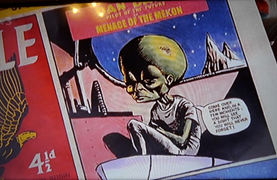


John Burns, who died on December 29th, aged eighty five, was one of Britain's greatest and most prolific comic strip artists. He was one of a very small group of artists who contributed to both versions of EAGLE. For the original version he illustrated the famous Wrath of the Gods strip, which joined EAGLE from Boys' World in 1964. He also illustrated episodes of the non fiction series 'Bids for Freedom' and 'Roving Reporter'. For the 1980s EAGLE he illustrated 'The Fists of Danny Pike', 'Dolebusters' and a 'Dan Dare' adventure. But EAGLE forms just a small part of his contribution to comics. His work in comics began with illustrations for Girl's Crystal and School Friend in the 1950s. After completing his National Service, he illustrated strip versions of several classic novels for D.C. Thomson. He illustrated 'Wulf the Briton' for Express Weekly in 1961 and then several strips and story illustrations for EAGLE's companion paper Robin, 'Kelpie the Boy Wizard' for Wham! and in the late sixties and early seventies, many strips for the TV based comics TV 21, Lady Penelope, Countdown and TV Action. He subsequently contributed many strips for the long running TV based magazine Look-In. He is well known on the continent for the Dutch sword and sorcery strip Zetari.

Excelling in both black and white and colour work, he also drew many newspaper strips, including 'The Seekers' for The Daily Sketch, 'The Tuckwells' for The Sunday Citizen, 'Jane' and 'Girl Chat' for The Daily Mirror, 'George and Lynne' for The Sun, 'Danielle' and 'Smythie' for The Evening News, 'Julia' for the German newspaper Bild and briefly, 'Modesty Blaise' for the Evening Standard. In recent years he became a major contributor to 2000 A.D. weekly, illustrating 'Nicolai Dante', 'Sinister Dexter', 'The Order' and 'Judge Dredd'. He also illustrated 'The Bendatti Vendetta' for the Judge Dredd Megazine.
.jpg)


By Christmas 1951, EAGLE's huge popularity was well established and a wide range of EAGLE and 'Dan Dare' related products had appeared on the market, creating Britain's first character based merchandising success. In the weeks leading up to Christmas, EAGLE advertised many of these products in its pages. They included EAGLE card games, jigsaws, projectors, stationery, balloons, transfer sheets, 'Dan Dare' ray guns, telescopes and ties, 'Riders of the Range' cowboy outfits, ties and braces and the first EAGLE Annual. In addition to the royalties they received for 'Dan Dare' and EAGLE related products, the copyright holders, Hulton Press also gained from the advertising potential that EAGLE provided. At a time when the market for toys, sweets and other merchandise for children and young people was large and growing and commercial television had not begun, EAGLE's popularity made it the ideal place to advertise and advertise they did. In the last November and the first December issues of 1951, EAGLE produced four page supplements filled with adverts for Christmas gifts and for many years to come, these supplements would continue.
The Christmas issue celebrated the occasion in style, with the letters of the title logo being covered with snow for the first of many times. The EAGLE symbol itself was backed by a Christmas night sky with the star of Bethlehem displayed prominently. At the top of the page, readers were greeted with 'A MERRY CHRISTMAS TO EAGLE READERS' and a decorative trim ran down the left side of the title box. Frank Hampson's 'Dan Dare' strip made a brief acknowledgement of Christmas, despite being in the middle of Dan's second adventure 'The Red Moon Mystery', which was not set at Christmas, when Digby compares himself to Rudolf the red nosed reindeer while struggling through a snowy Martian landscape.
On page three, the 'PC 49' adventure was also an ongoing serial and made no mention of the season. This strip by Alan Stranks was now drawn by John Worsley, who had replaced Strom Gould earlier in the year. Christmas was recognised in an article on pages four and five, by EAGLE's Special Investigator Macdonald Hastings, who wrote about driving an old Royal Mail Coach pulled by four horses, which is an image often depicted on Christmas cards and strongly associated with Christmas, thanks to Charles Dickens. This page also carried an 'EAGLE Window' box. These small boxes appeared weekly and advertised EAGLE merchandise. The 'EAGLE Window' in the Christmas issue was number 34, which gives an indication of the number of licensed products available and there would be many more. This particular window listed several products which cost less than four shillings and gave their prices. The bottom half of page five was devoted to adverts for Caley's Chocolates and Philidyne Cycle Dynamo Lighting Sets.
Page six was the Sports page and it acknowledged the season with a Christmas Soccer Quiz, with questions set by Arsenal's players. At the bottom of the page, the comedy strip 'Grandpa' by Peter Probyn shows the title character buying and wrapping a large present and then opening it himself on Christmas morning - a joke used many years later by Rowan Atkinson as Mr. Bean. Page seven was the 'Riders of the Range' serial 'The Secret of Ghost Mountain', which made no mention of Christmas. This strip, written by Charles Chilton, was now drawn by Angus Scott, who drew three serials before being replaced by Frank Humphris in 1952. The top half of the colour centrespread was a series of pictures by Leslie Ashwell Wood, showing how the King's Christmas Message was transmitted from Sandringham via Broadcasting House to homes in Britain and throughout the Commonwealth. Readers would be unaware that his 1951 Christmas Message would be the King's last, as he died less than two months later, to be succeeded by his daughter, Queen Elizabeth II. The Christmas Messages were only broadcast on radio until 1957.
The lower part of the centrespread was the latest episode in the 'Tintin' adventure 'King Ottokar's Sceptre'. This story marked Tintin's first ever appearance in English and came seven years before Methuen began publishing his adventures in albums. Created by the Belgian artist, Georges Remi (who wrote and drew as Herge), the boy reporter Tintin was a huge success with young readers on the continent and would later enjoy great success in Britain, with translations by Leslie Lonsdale Cooper and Michael Turner. However, his first appearance was not a great success in EAGLE and this was the only story to be adapted. This first translation, by an unknown translator retained all the original French names of the characters, with the exception of the inept detectives Dupond and Dupont, who were renamed Thompson and Thomson. Lonsdale Cooper and Turner kept these English names in their own translation and anglicised the names of the other characters, such as Tintin's dog Milou, who was renamed Snowy. As an ongoing serial and part of an already completed story, the 'Tintin' strip made no mention of Christmas.


Page twelve was entirely devoted to 'Christmas Party Games'. Most of the games described were traditional games, but intriguingly the last game was 'The Dan Dare Game'. However, this was actually a simple tag game, with space pilots trying to get from one base (Earth) through 'space' occupied by Treens, who would try to tag the pilots before they reached their other base (Venus). The top half of page thirteen was 'Can You Beat It?' a regular informative strip and in this issue the information was all about Christmas. Readers were informed that there had only been nine white Christmases in the twentieth century (up until then) and that the first Christmas card had been designed by J.C. Horsley in 1843. The bottom half of the page was devoted to adverts for Subbuteo Table Soccer, Stamp Collecting and ballpoint pens and a plea for readers to save money for the N.S.P.C.C. Both Subbuteo and Philidyne Cycle Dynamo Lighting Sets were also advertised in the 1950 Christmas issue. On page fourteen was John Ryan's comedy strip 'Harris Tweed, Extra Special Agent' and as Tweed's adventures were single episode stories, this one was devoted to Christmas, with Tweed being tied up by thieves at a Christmas party and wrapped up in a giant Christmas Cracker. Fortunately his young assistant manages to catch the thieves and Tweed manages to claim the credit as usual.

On page fifteen in the 'Tommy Walls' strip, sponsored by Walls Ice Cream, Tommy and his friends catch a villainous department store Santa who is hiding stolen watches in one of his Christmas present boxes, ready to sneak them out of the store later. This strip was drawn and probably also written by Richard Jennings, who had a long run illustrating 'Tommy Walls' before moving on to 'Storm Nelson' in October 1953. Jennings also wrote many of the 'Tommy Walls' stories. He would later take over the writing of 'Storm Nelson' when the original writer left the strip and he adapted Arthur Conan Doyle's The Lost World for EAGLE in 1962, for a strip drawn by Martin Aitchison.
The final page of this issue was the first part of a retelling of the story of the birth of Christ, from the viewpoint of a shepherd boy. Called 'The Shepherd Lad of Bethlehem' it was drawn by the regular back page artist Norman Williams and ran to just two instalments. The first episode ends with the shepherds visiting the baby Jesus and the second features the wise men, one of whom arrives on an elephant! Camels -yes, but an elephant!? The strip also features a winged angel choir and snow on the hills, which contrasts strongly with Morris and Frank Hampson's 1960 retelling of the story of Jesus' life, which took a more grounded approach.


A notable feature of the 'Dan Dare' strip, particularly in the early days, was that Dan and Digby had relatives, several of whom appeared in the strip. In the original Venus story, Digby actually has a wife and family, who are again featured in a text story in the 1953 Dan Dare Annual, called 'Aunt Anastasia Comes to Stay'. However, with the notable exception of Aunt Anastasia, Digby's family are forgotten in later stories. Aunt Anastasia actually helps to defeat the Mekon's plans to conquer Earth in the first Venus story, when she realises that Digby's apparently reassuring message from Venus about the Treens (made under duress) is actually a clever coded warning. Her contribution leads to Dan Dare calling his new Spaceship 'Anastasia' in her honour. Digby's Aunt appears again at the end of 'Marooned on Mercury' and in two EAGLE Annual stories 'The Double Headed Eagle' and ''Operation Triceratops'. She features alongside many other characters from the saga in Keith Watson's final frame for 'The Menace From Jupiter' in 1967, when Dan was promoted to Spacefleet Controller and even appears in a 'Dan Dare' strip in the new version of EAGLE in 1990 in a story also drawn by Keith Watson.

Not to be outdone, Dan Dare's Uncle Ivor, an archaeologist, plays a major part in the second 'Dan Dare' adventure 'The Red Moon Mystery', informing Dan of the last visit of the deadly 'Red Moon', many thousands of years earlier, when it destroyed civilisation on Mars. He also appears briefly alongside Aunt Anastasia at the end of 'Marooned on Mercury', but plays a bigger role in 'The Phantom Fleet', where he is one of a group of V.I.P.s on a new spacecraft which is captured by an aquatic race who wish to settle in one of Earth's oceans and he becomes involved in successful peace talks with them. He makes his last appearance in EAGLE in the final frame of 'The Menace From Jupiter'. He also appears in Basil Dawson's 1956 novel Dan Dare on Mars. Three other relatives of Dan also feature in the saga. His nephew, Alastair features in 'The Double Headed Eagle' in EAGLE Annual Number Three, when he competes in the Interplanetary Olympic Games on Venus. Another nephew, Nigel, appears in the weekly EAGLE in the 1964 adventure 'The Big City Caper'. He is a member of a group of disaffected youths who the villain Xel tries to recruit to his cause, but is too sensible to be influenced by the evil megalomaniac. We never learn whether Nigel and Alastair are brothers. The eccentric Uncle Ivor comes across as a confirmed bachelor, which suggests that Dan must have at least one more Uncle.
The last member of Dan's clan to play a part in the saga is his father, William Dare, who does not actually appear in the story, but is strongly referenced in 'Safari in Space', 'Terra Nova' and 'Trip to Trouble' in 1959. In this series of adventures, Dan travels to another star to search for his father who went missing on an expedition many years earlier. Sadly, the story ends with the discovery that his father has died.
Eaglers were sorry to hear of the death of Sir Bobby Charlton last week. Bobby had a strong connection with EAGLE many years before he became a World Cup winner with England and a European Cup winner with Manchester United, for he was voted EAGLE Sportsman of the Year for three years in succession, from 1958 to 1960, being the final recipient of the award and the only person to win it three times. He also contributed to a series called 'Soccer- The Bobby Charlton Way' for EAGLE in 1960, where he demonstrated skills in a series of photographs. Bobby experienced tragedy as well as success in his life, surviving the Munich air crash in February 1958, when many of his team mates were killed. The picture below was published in EAGLE when Bobby won his first Sportsman of the Year award. Bobby told readers that he enjoyed reading the Cutaway drawings as he had considered a career in engineering.
After leaving Manchester United in 1973, Bobby became manager of Preston North End and later also played for Preston, where I watched him many times. After leaving Preston, he became a Director of Wigan Athletic and subsequently joined the Board of Manchester United. He was a true sportsman and a great example to the young - a worthy EAGLE Sportsman of the Year.
(Tribute by Steve Winders)


