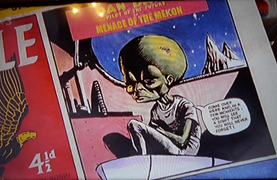
By Christmas 1951, EAGLE's huge popularity was well established and a wide range of EAGLE and 'Dan Dare' related products had appeared on the market, creating Britain's first character based merchandising success. In the weeks leading up to Christmas, EAGLE advertised many of these products in its pages. They included EAGLE card games, jigsaws, projectors, stationery, balloons, transfer sheets, 'Dan Dare' ray guns, telescopes and ties, 'Riders of the Range' cowboy outfits, ties and braces and the first EAGLE Annual. In addition to the royalties they received for 'Dan Dare' and EAGLE related products, the copyright holders, Hulton Press also gained from the advertising potential that EAGLE provided. At a time when the market for toys, sweets and other merchandise for children and young people was large and growing and commercial television had not begun, EAGLE's popularity made it the ideal place to advertise and advertise they did. In the last November and the first December issues of 1951, EAGLE produced four page supplements filled with adverts for Christmas gifts and for many years to come, these supplements would continue.
The Christmas issue celebrated the occasion in style, with the letters of the title logo being covered with snow for the first of many times. The EAGLE symbol itself was backed by a Christmas night sky with the star of Bethlehem displayed prominently. At the top of the page, readers were greeted with 'A MERRY CHRISTMAS TO EAGLE READERS' and a decorative trim ran down the left side of the title box. Frank Hampson's 'Dan Dare' strip made a brief acknowledgement of Christmas, despite being in the middle of Dan's second adventure 'The Red Moon Mystery', which was not set at Christmas, when Digby compares himself to Rudolf the red nosed reindeer while struggling through a snowy Martian landscape.
On page three, the 'PC 49' adventure was also an ongoing serial and made no mention of the season. This strip by Alan Stranks was now drawn by John Worsley, who had replaced Strom Gould earlier in the year. Christmas was recognised in an article on pages four and five, by EAGLE's Special Investigator Macdonald Hastings, who wrote about driving an old Royal Mail Coach pulled by four horses, which is an image often depicted on Christmas cards and strongly associated with Christmas, thanks to Charles Dickens. This page also carried an 'EAGLE Window' box. These small boxes appeared weekly and advertised EAGLE merchandise. The 'EAGLE Window' in the Christmas issue was number 34, which gives an indication of the number of licensed products available and there would be many more. This particular window listed several products which cost less than four shillings and gave their prices. The bottom half of page five was devoted to adverts for Caley's Chocolates and Philidyne Cycle Dynamo Lighting Sets.
Page six was the Sports page and it acknowledged the season with a Christmas Soccer Quiz, with questions set by Arsenal's players. At the bottom of the page, the comedy strip 'Grandpa' by Peter Probyn shows the title character buying and wrapping a large present and then opening it himself on Christmas morning - a joke used many years later by Rowan Atkinson as Mr. Bean. Page seven was the 'Riders of the Range' serial 'The Secret of Ghost Mountain', which made no mention of Christmas. This strip, written by Charles Chilton, was now drawn by Angus Scott, who drew three serials before being replaced by Frank Humphris in 1952. The top half of the colour centrespread was a series of pictures by Leslie Ashwell Wood, showing how the King's Christmas Message was transmitted from Sandringham via Broadcasting House to homes in Britain and throughout the Commonwealth. Readers would be unaware that his 1951 Christmas Message would be the King's last, as he died less than two months later, to be succeeded by his daughter, Queen Elizabeth II. The Christmas Messages were only broadcast on radio until 1957.
The lower part of the centrespread was the latest episode in the 'Tintin' adventure 'King Ottokar's Sceptre'. This story marked Tintin's first ever appearance in English and came seven years before Methuen began publishing his adventures in albums. Created by the Belgian artist, Georges Remi (who wrote and drew as Herge), the boy reporter Tintin was a huge success with young readers on the continent and would later enjoy great success in Britain, with translations by Leslie Lonsdale Cooper and Michael Turner. However, his first appearance was not a great success in EAGLE and this was the only story to be adapted. This first translation, by an unknown translator retained all the original French names of the characters, with the exception of the inept detectives Dupond and Dupont, who were renamed Thompson and Thomson. Lonsdale Cooper and Turner kept these English names in their own translation and anglicised the names of the other characters, such as Tintin's dog Milou, who was renamed Snowy. As an ongoing serial and part of an already completed story, the 'Tintin' strip made no mention of Christmas.

Two half page informative strips occupied page ten and both related to Christmas. The first was in the series 'Great Headlines of the Past' and covered the unofficial 1914 Christmas Truce in the First World War, which oddly did not mention the football matches which took place between British and German troops. The second strip was in the series 'Eagle Eye Nature Detective', a series sponsored by Rowntree's Chocolate, which told the story of mistletoe. Page eleven was the Editor's Page and
EAGLE's editor, the Rev. Marcus Morris used his letter to remind readers of the religious basis of Christmas. His reason for launching
EAGLE was to promote Christian values and ironically, its success had led to it becoming rather focussed on promoting merchandising! He was clearly anxious that its primary purpose should not be lost. To this end, he also encouraged readers to attend
EAGLE's first Carol Service, which was to be held at St. Paul's Cathedral on December 22nd. There was clearly a minor panic behind the scenes about the Carol Service as Morris informed readers in two places on the page and in bold letters that the service would begin at 2.30 p.m. and not 3.30 as stated in previous issues! In future years,
EAGLE would organise several carol services each Christmas, which would be held all over the country, usually presided over by either Morris himself or the Rev. Chad Varah, who wrote many back page biographical strips and other features for
EAGLE. Varah also took over the scripting of the next 'Dan Dare' adventure 'Marooned on Mercury' when Frank Hampson fell ill. The Editor's Page also included Christmas Greetings accompanied by small pictures of their characters, by
EAGLE's artists and the three picture 'Chicko' strip by Norman Thelwell also took a Christmas theme as Chicko slept in his Christmas stocking, leaving a note asking Santa to put his presents in his bed.
Also on the Editor's Page was a 'Competition Corner' with Christmas based puzzles and a 'Bertram Mills Circus Competition' offering prizes to EAGLE Club members of tickets for the Circus, which in those days spent the Winter season at Olympia in London. The bottom corner of the page advertised the latest EAGLE Club Diary. Readers were regularly invited to join the EAGLE Club, which offered tickets to sports events and shows as well as special offers on some merchandise and access to certain competitions. Initially readers could join for a shilling, which quickly rose to one shilling and sixpence, for which they received a membership card and a metal badge. The Club was a way of securing reader loyalty, but it also emphasised that EAGLE wanted to be more than just a weekly magazine. It wanted to guide its readers to become responsible people. Such innovations as 'Mug of the Month', which rewarded readers for service to others, show this aim quite clearly. EAGLE also organised activity holidays for Club members, including the EAGLE/YHA Adventure Holiday Scheme. Another innovation was the EAGLE and Girl Table Tennis Tournaments, which began in 1954. Although many readers joined the Club, obviously many others did not and consequently EAGLE offered many activities that were not available to everyone. The first clear sign of this problem came with the second year of the Table Tennis Tournament. In the first year, only Club members could take part, but in the second it was open to all and this was strongly emphasised in the publicity. The Club was nevertheless a success for it ran for ten years before being disbanded during Clifford Makins' editorship, but opportunities for readers were maintained.

Page twelve was entirely devoted to 'Christmas Party Games'. Most of the games described were traditional games, but intriguingly the last game was 'The Dan Dare Game'. However, this was actually a simple tag game, with space pilots trying to get from one base (Earth) through 'space' occupied by Treens, who would try to tag the pilots before they reached their other base (Venus). The top half of page thirteen was 'Can You Beat It?' a regular informative strip and in this issue the information was all about Christmas. Readers were informed that there had only been nine white Christmases in the twentieth century (up until then) and that the first Christmas card had been designed by J.C. Horsley in 1843. The bottom half of the page was devoted to adverts for Subbuteo Table Soccer, Stamp Collecting and ballpoint pens and a plea for readers to save money for the N.S.P.C.C. Both Subbuteo and Philidyne Cycle Dynamo Lighting Sets were also advertised in the 1950 Christmas issue. On page fourteen was John Ryan's comedy strip 'Harris Tweed, Extra Special Agent' and as Tweed's adventures were single episode stories, this one was devoted to Christmas, with Tweed being tied up by thieves at a Christmas party and wrapped up in a giant Christmas Cracker. Fortunately his young assistant manages to catch the thieves and Tweed manages to claim the credit as usual.

On page fifteen in the 'Tommy Walls' strip, sponsored by Walls Ice Cream, Tommy and his friends catch a villainous department store Santa who is hiding stolen watches in one of his Christmas present boxes, ready to sneak them out of the store later. This strip was drawn and probably also written by Richard Jennings, who had a long run illustrating 'Tommy Walls' before moving on to 'Storm Nelson' in October 1953. Jennings also wrote many of the 'Tommy Walls' stories. He would later take over the writing of 'Storm Nelson' when the original writer left the strip and he adapted Arthur Conan Doyle's The Lost World for EAGLE in 1962, for a strip drawn by Martin Aitchison.
The final page of this issue was the first part of a retelling of the story of the birth of Christ, from the viewpoint of a shepherd boy. Called 'The Shepherd Lad of Bethlehem' it was drawn by the regular back page artist Norman Williams and ran to just two instalments. The first episode ends with the shepherds visiting the baby Jesus and the second features the wise men, one of whom arrives on an elephant! Camels -yes, but an elephant!? The strip also features a winged angel choir and snow on the hills, which contrasts strongly with Morris and Frank Hampson's 1960 retelling of the story of Jesus' life, which took a more grounded approach.
This second Christmas
EAGLE certainly acknowledged the season and despite the fact that its popularity had made it a merchandising gold mine, it also managed to promote the Christian significance and message in its pages. The confusion about the starting time for the Carol Service did not affect its success and the Annual Carol Services became a highlight of the Christmas season for many readers as services were held all over the country for the next decade.