WELCOME

Welcome to the web home of THE EAGLE SOCIETY.

THE EAGLE SOCIETY is dedicated to the memory of EAGLE - Britain's National Picture Strip Weekly - the leading Boy's magazine of the 1950s and 1960s. We publish an A4, quarterly journal - the Eagle Times.

This weblog has been created to provide an additional, more immediate, forum for news and commentary about the society and EAGLE-related issues. Want to know more? See First Post and Eagle - How it began.

Saturday, 18 February 2023

IN AND OUT OF THE EAGLE 37


The Dan Dare strip has inspired many parodies and other humorous strips. Danny Dare in Wham! comic was an early example. There were two Dan Dires; one by fan Eric Mackenzie and the other a political satire in Private Eye magazine. Another political satire was Dan Blair in the Times by Peter Brookes and our own Ray Aspden produced Mekki and Our Albert for Spaceship Away. However the strip which most impressively reflected Frank Hampson’s splendid visuals was Ham Dare, a strip which ran in Oink! comic in 1986. Oink! was an attempt to create an anarchic children’s comic in the style of the adult Viz. As its name suggests, Oink! adopted a pig theme in keeping with its often vulgar humour and several popular fictional characters were reimagined as pigs.  Written by Lew Stringer and illustrated in lavish colour by Malcolm Douglas (using the pseudonym J.T. Dogg), Ham Dare stayed remarkably faithful to Hampson’s designs, contrasting strongly with the ‘serious’ attempts to bring Dan Dare back. The story, which also featured ‘Pigby’, ‘Sir Hogbert’ and the ‘Weakon’ avoided the vulgarity that was often prevalent in some of Oink’s other stories. The Ham Dare serial ran from issues 15 to 19 of the then fortnightly comic, but Ham also featured in the 1989 Oink! Annual and the 1989 Summer Special. Sadly, Malcolm Douglas died in 2009 at the early age of 54, but Lew Stringer, who is also a prolific comic artist, is still going strong. 


IN AND OUT OF THE EAGLE 36

There is still a publication that bears the name EAGLE produced currently in Britain, although the title is actually in Latin. Aquila is a monthly educational magazine for 8-14 year olds which contains a mix of factual articles, challenging puzzles and fun activities, designed to stimulate and enhance children's skills and knowledge. It is produced by a small independent publisher called New Leaf Publishing, based in Eastbourne and is available internationally by subscription, with many schools as well as individuals subscribing. It carries no advertising and prides itself on its substantial text content, which contrasts strongly with most magazines published for children today. Despite its aims and educational content, Aquila bears little resemblance to our EAGLE or indeed to the famous educational magazine Look and Learn. Nevertheless it is a commendable publication and most importantly it is actually read by children. It has been running for thirty years and has a readership of 35,000. 
  

Friday, 10 February 2023

IN AND OUT OF THE EAGLE 35

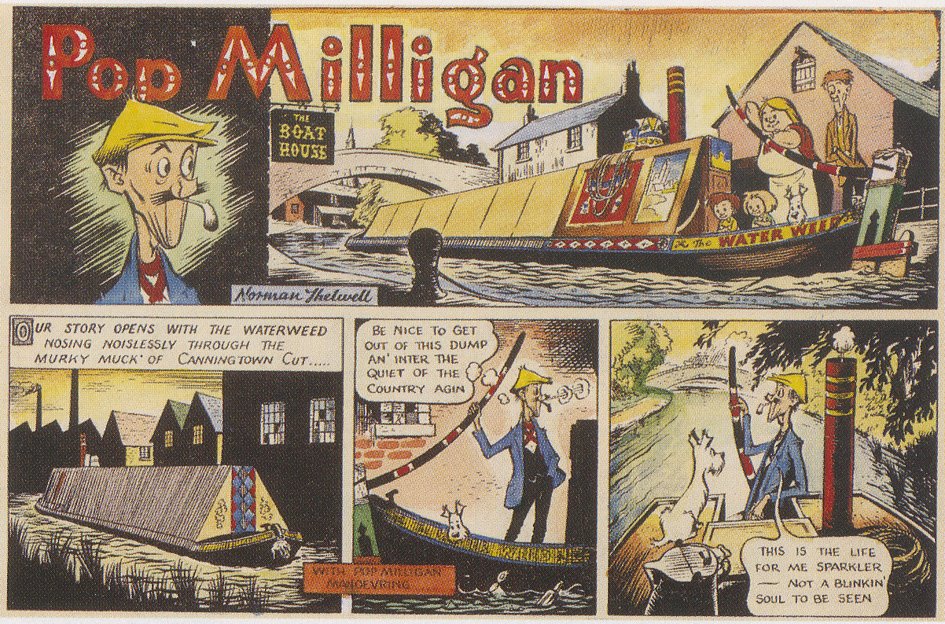
After Dan Dare, EAGLE's longest running character was Chicko, the three picture comedy strip by Norman Thelwell, which appeared weekly on the Editor's Page. This strip about a young boy contained no dialogue, although it often contained writing in the form of signs, book titles or notices. The strip appeared in the first six issues of EAGLE, from April 1950, before taking a break of three months, during which time Thelwell moved from the Wirral to Codsall to take up a teaching post at Wolverhampton College of Art. Chicko returned to EAGLE in August (issue 20) and then continued weekly until 1962 when EAGLE was radically overhauled. Chicko's last appearances were in the 1962 EAGLE Holiday Extra and the EAGLE Annual for 1963. Thelwell's EAGLE connection began when he produced some cartoons for Marcus Morris' Parish magazine Anvil and he subsequently drew a half page strip called Pop Milligan, about a canal bargee. This strip was included in the dummy edition of EAGLE which Morris submitted to publishers in 1949. However it did not appear in the published weekly.


Thelwell also produced cartoons for Punch, illustrating more than 1,600 over a twenty five year period. He contributed political cartoons for the News Chronicle and later the Sunday Dispatch. He became famous for his Punch cartoons about the changing countryside and little girls on horseback and subsequently created Penelope and her horse Kipper for the Sunday Express in 1962. Many of his cartoons were collected in books and he became one of the best known of EAGLE's contributors. He died in 2004.


IN AND OUT OF THE EAGLE 34

Martin Mere was the title of one of several strips that Frank Hampson produced for EAGLE after The Road of Courage ended, but were never developed. In fact it was Joan Porter who was still working as Frank's assistant who devised the title, characters and basic synopsis of this story. Only one episode was illustrated but it was arguably the most intriguing of all the proposed strips. Produced in colour and set in the swamplands of Mercia during Saxon times, the hero was Martin Mere, who was Guardian of the swamplands. Martin Mere is also the name of a wetland area in Lancashire, which was once the largest body of freshwater in England. As late as 1579 it extended from Burscough in the east to Churchtown in the west where Frank’s first studio would be located. Today Martin Mere is significantly smaller than it was in Saxon times.

 It houses a popular Wetland Centre managed by the Wetland and Wildfowl Trust. Joan located the strip in the Saxon Kingdom of Mercia,whose power base was in the Midlands, leading some fans to assume the marshes in the strip were also in the Midlands, but for several centuries Mercia extended as far north as the River Ribble, meaning that Martin Mere was actually only just located in Mercia, close to its border with Northumbria, so it is clear that the mere that Martin protected was actually Martin Mere. A track called 'the Ridgeway' is mentioned in the strip, but it does not refer to the ancient road known by this name, which follows a ridge of chalk hills in southern England. Sadly only a poor black and white copy of the episode survived, but the comic artist Martin Baines, who was a member of our Society in his boyhood and is still a keen Dan Dare enthusiast, improved the resolution on the page using Photoshop and this is reproduced below. 

The single episode introduces the hero and the basic plot. Martin and his men meet a group of Moorish travellers on the marsh and accompany them to their Lord. The episode ends with one of  Martin's men being alarmed by what he finds in the travellers' cart. We will never know what he found. 

Had circumstances been different and Frank had been allowed to develop this strip, it is possible that some changes would have been made before publication - Dan Dare was originally a clergyman! The name of the hero might well have changed, as although there was already a saint called 'Martin', I have never heard of any Anglo Saxons taking the name before the Norman Conquest. Despite there being only one episode, it is possible to date the events of the story to around 700 A.D and certainly between abut 650 and 800 A.D. In 700, Mercia was a powerful kingdom and was Christian from around 650. The Moors in the story are apparently from Morocco as they are trading the 'riches of Barbary' which is in north west Africa. A Moorish army invaded Spain, in 711 A.D.     


Thursday, 22 December 2022

THE FIRST CHRISTMAS EAGLE by John Culshaw

Not surprisingly, EAGLE always celebrated Christmas and particularly so in the 1950s when it was edited by the Rev. Marcus Morris. The very first Christmas EAGLE set an impressive precedent, with the front page bordered with holly and the action in Dan Dare's long running Venus saga taking a short break as the characters aboard the Ranger spaceship reflected on the fact that it was Christmas, which led into scenes back home on Earth. The strip, produced by Frank Hampson and his studio team, continued on page two where Sir Hubert Guest, Digby and Professor Peabody also reflected on Christmas back home, despite the fact that they were prisoners of the Mekon. The episode ended with Dan himself in the land of the friendly Therons, planning a rescue mission.   

Inside the issue, PC 49 continued his adventures on page three and made no mention of the season as it would have clashed with the storyline, where 'Fortynine' is on the trail of a dangerous gang who have killed a fellow officer. PC 49 originated as a weekly radio series by Alan Stranks, who also wrote the EAGLE strip, which was then drawn by Strom Gould and would later be drawn by John Worsley, who took over in August 1951 and drew the strip until it ended in March 1957. On pages four and five, the text serial Thunder Reef , about smuggling on the Brittany coast, written by Adrian Seligman continued and again, not surprisingly, there was no mention of Christmas. The 'drop in' illustrations for this story were by John Worsley. Page six was divided into a half page Football Hints strip by Billy Wright, the England captain, which focussed on proper maintenance of kit and two short features on collecting. The first provided ideas for making scrap books and the other was for stamp collectors, with neither relating to Christmas. 
The colour page seven marked the very first episode of Riders of the Range, from the popular radio serials by Charles Chilton. Although Christmas played no part in Jeff Arnold's first episode, his arrival in EAGLE was quite special. The strip would run for more than eleven years. The first episode was drawn by Jack Daniel, who would illustrate the first two adventures before Angus Scott took over for the next three until Frank Humphris became the regular artist from 1952 to the strip's end in 1962, later illustrating Blackbow the Cheyenne until EAGLE's merger with Lion in 1969. The cutaway drawing on the top half of the centre spread was of the underground railway operated by the Post Office to carry mail between Paddington and Whitechapel, with the text emphasising the Christmas mail. The cutaway was drawn by Leslie Ashwell-Wood, who was the most prolific of EAGLE's cutaway artists. On the bottom half of the centrespread was an imported French strip called Skippy the Kangaroo, which had no connection with the later Australian TV series. This Skippy, drawn in a basic cartoon style, was a continuing story and did not relate to Christmas. It was credited to Danay, Dubriscay and Genestre and described as an Andre Sarrut production, which seems like a lot of people to produce such a simple strip, but this team were then in the process of making a cartoon feature film in France based on a Hans Anderson story, with the hope of building up a cartoon film studio to rival Disney. Unfortunately problems beset the company and while the film was shown unofficially against the director Paul Grimault's wishes in 1952, disagreements between Sarrut and Grimault resulted in it not being released properly until 1980! Consequently it never had the opportunity to succeed. Possibly Skippy was to have been their next film project. 

On the next page (ten) also in colour, two half page strips told the story of the Glastonbury thorn bush which reputedly flowers on Christmas Day and the origin of the Christmas tree, which was brought by Prince Albert from Germany, but was actually originated by an English missionary St. Winfred (also known as St. Boniface). Page eleven included the Editor's letter to readers and Marcus Morris used it to wish them a happy Christmas. He apologised that the issue was unable to provide more pages than the usual sixteen, writing that paper was still very scarce and continuing: 
"..but we have done what we can to give it a Christmassy look and to include a number of features telling you about Christmas traditions and customs. Most important of all, you will find on the back page the reason why we keep Christmas at all - the story of the birth of Jesus Christ over nineteen hundred years ago in the stable at Bethlehem." 
He was referring to The Great Adventurer, the long running serial on page sixteen about the life of St. Paul, where Christmas was cleverly included in the strip as Paul told his audience at Philippi the story of Jesus' birth. This strip was still being produced by Frank Hampson's team, with Jocelyn Thomas as principal artist. They would hand over briefly to Alfred Sindall early in 1951, before Norman Williams took over as the regular back page biographies artist in February 1951. 

Meanwhile, back on page eleven still, Norman Thelwell's weekly three frame Chicko comedy strip featured Christmas and there was also a half page Competition Corner with a series of Christmas based puzzles and activities. Due to paper shortages EAGLE never wasted space and Readers' Letters also appeared on this page, although none related to Christmas. Page twelve was a one off Christmas text story Bagpipes for the Gallant, about a young Scots lad who gets the set of bagpipes he had always wanted after saving his sister's life and his family cottage by putting out a fire. It was written by E. Vincent, who was Ellen Vincent, the Assistant Editor of EAGLE. The 'drop in' pictures were by Will Nickless, who had illustrated the Worzel Gummidge books of Barbara Euphen Todd during the 1940s and would later produce illustrations for many children's books, including EAGLE and Swift Annuals. The top half of page thirteen was a Sporting Personalities strip about the showjumper Lt. Colonel Harry M. Llewellyn O.B.E. This was drawn by 'Ross' who we now know was really Ron Smith, who would go on to have a long career in comic strip illustration. His future work would include many strips for D.C. Thomson's comics and Judge Dredd in 2000 A.D. weekly thirty years later. 'Ross' had also illustrated the short strip about the origin of the Christmas tree in the same issue. The bottom half of page thirteen featured advertisements for Rolo, Subbuteo Table Soccer and Philidyne Cycle Dynamo Lighting Sets. 

On page fourteen, John Ryan's Harris Tweed Extra Special Agent 'solves' (if that's the right word!) The Case of the Two Father Christmases in a complete whole page adventure and on page fifteen Tommy Walls, a full page strip sponsored by Walls Ice Cream also had a one off Christmas adventure about turkey thieves, illustrated by Richard Jennings and despite the cold weather, Tommy continued to encourage readers to eat ice cream. Although this was essentially an advertising strip, Tommy Walls was extremely popular with readers, especially after it changed from one off stories to continuing ones in May 1952. Tommy was actually granted a four page colour strip in the second EAGLE Annual, produced for Christmas 1952 - the only occasion that he didn't eat or refer to Walls Ice Cream. First drawn by Frank Hampson in Issue One, the strip was later drawn by Eric Parker (of Sexton Blake fame), John Worsley, Walter Pannett, Harold Johns and Richard Jennings. Jennings also wrote many scripts for Tommy Walls and he would continue working for EAGLE after Tommy Walls ended, drawing and eventually writing the Storm Nelson-Sea Adventurer strip. Later he would be well known for his Dalek strips in TV Century 21 and Dalek books. 

In subsequent years the issues leading up to Christmas would feature a lot of adverts for EAGLE related merchandise, but despite its overnight success, EAGLE's publisher, Hulton Press and other companies were not yet ready to cash in, although Hulton did release an EAGLE Diary for 1951 and The EAGLE Book of Adventure Stories, but there was no EAGLE Annual until the following year. This might suggest that Hulton and Britain's toy companies were slow off the mark,  but there were still shortages of many commodities as a result of the War and some rationing was still in progress. EAGLE's success had exceeded all expectations and annuals were significant publications in the 1950s and 60s, so additional staff had to be appointed to build on the initial success. In fact Dan Dare would be Britain's first heavily merchandised fictional character, with toys, clothes, filmstrip projectors, books, tooth powder, brushes, watches, cups, card games, Easter eggs and transfers being produced.    

Although EAGLE's huge popularity ensured that commercialism seemed to dominate the publication, in later years, the religious significance of Christmas was always promoted in the Christmas issues throughout the editorships of Marcus Morris and his successor, Clifford Makins. Perhaps ironically, it was only in the 1960s when the declining popularity of Dan Dare and EAGLE meant that they were no were no longer being heavily merchandised, that the religious aspect was overlooked. 

I am grateful to Lew Stringer for allowing me to use his scans of the front page of the Christmas EAGLE and the Chicko strip and to Richard Sheaf and Steve Winders for providing and clarifying some information.

Sunday, 18 December 2022

EAGLE TIMES Vol.35 No.4 Winter 2022

The Winter issue of EAGLE Times is out now. This edition contains a tribute to our late Queen Elizabeth II by David Britton, who also contributes the final instalment of his series about the Canadian Pacific Railway and the final part of his detailed examination of the Riders of the Range adventure Last of the Fighting Cheyenne. Also in this issue is EAGLE and the Changing Face of Christmas by Andrew Newman, The Day I Met Frank Hampson by John Liffen, another In and Out of the EAGLE by Jim Duckett, the final episode of my latest Archie Willoughby adventure and my short appraisal of the third Luck of the Legion novel Carry On Sergeant Luck. The issue also contains details of our next annual gathering, which will be held at York from April 11th - 13th. 

Wednesday, 7 December 2022

JOAN PORTER (1926 - 2022) A tribute to the late EAGLE artist by Steve Winders

Joan Porter (nee Humphries), the last surviving member of Frank Hampson's original team who worked on the creation of Dan Dare and several other strips for the EAGLE has died aged 96. Joan was employed as a colourist, photographer, researcher, secretary and costume maker. She was there at the beginning, from late 1949, when Frank and his team worked in the old Bakehouse in Churchtown, Southport and there at the end of his time on EAGLE, remaining with him in 1959 when he gave up the Dan Dare strip to assist him on his final strip for the paper, The Road of Courage, which ran in EAGLE until Easter 1961. An unassuming versatile lady with a fine sense of humour, I met her only once and then briefly, at the opening of the 1990 Dan Dare Exhibition in the Atkinson Arts Centre in Southport. However I did converse with her by e-mail when I was researching an article for EAGLE Times on Frank's back page strip The Great Adventurer and she was most helpful and enthusiastic, kindly providing me with many details of its production. In his quest for perfection, Frank used members of his team to pose in costume for photographs of scenes that could then be drawn more accurately and on The Great Adventurer, Joan made costumes, coloured pages, assisted with research and filed information garnered by the research. Her role in the production of the Dan Dare strip was the same. In the interests of accuracy and consistencysignificant research was carried out and references for all aspects of the strip were kept and Joan organised and catalogued this. She also became the principal photographer. Her organisation was a key factor in the high quality and success of the strip. 
She will be greatly missed. Her passing marks the end of an era in the Dan Dare story.