WELCOME

Welcome to the web home of THE EAGLE SOCIETY.

THE EAGLE SOCIETY is dedicated to the memory of EAGLE - Britain's National Picture Strip Weekly - the leading Boy's magazine of the 1950s and 1960s. We publish an A4, quarterly journal - the Eagle Times.

This weblog has been created to provide an additional, more immediate, forum for news and commentary about the society and EAGLE-related issues. Want to know more? See First Post and Eagle - How it began.

Saturday, 30 April 2022

THE GORDON AND GOTCH STORY

 JOE HOOLE EXAMINES THE REMARKABLE STORY OF EAGLE'S PRINCIPAL INTERNATIONAL DISTRIBUTOR.  

Their name appears in every single issue of Eagle, Girl, Swift, Robin and Boys’ World and in every issue of the 1980s Eagle and countless other British comics and magazines, although most readers probably never saw it. Along with the title and Dan Dare, Gordon and Gotch and the Central News Agency of South Africa are the only other constant names in the two versions of Eagle. Gordon and Gotch appeared at the bottom of a page in the publisher’s details as the ‘sole agents for Australia and New Zealand’ and the Central News Agency as agents for South Africa. These two companies were independent of each other, but had worked closely together since 1904 when they reached an agreement that Gordon and Gotch would become sole agents for C.N.A. in Britain while their branches in the Cape and Natal would be taken over by C.N.A. 

Born in Kettering Northamptonshire in 1829, John Speechly Gotch was a dentist, who sailed from Liverpool to seek his fortune in the U.S.A. in 1849. While in New York to learn about the manufacture of false teeth he heard about the discovery of gold in Victoria and in 1853 he sailed on the clipper Peytona, bound for Australia. However the ship was wrecked off the coast of Mauritius and Gotch escaped with only his nightshirt on his back and penniless. He worked as a dentist in Mauritius for eleven weeks to earn enough money for his passage to Melbourne and on arrival he made for Fryer Creek near Castlemaine where the latest gold strike had been reported. The above painting from 1855 by Edwin Stocqueler shows gold digging in Australia. Unfortunately all Gotch found was a small nugget worth about £3 before he ran out of money and provisions. He also injured his foot with a pick. He returned to Melbourne on the back of a teamster’s wagon, because he could hardly walk and he was almost penniless again – he actually had tuppence ha’penny left. There he met a Scotsman called Alexander Gordon who ran a market stall which sold newspapers and was also an advertising agent for the Melbourne Argus. He initially offered John a job selling papers and organising advertisers, but Gotch proved so adept that a few weeks later Gordon offered him a partnership which depended on his ability to sell as many newspapers in the diggings as Gordon sold on his stall. Both men flourished and the partnership was duly established. It was suggested that they should have an agreement drawn up by a lawyer, to which Gordon responded “If we are honest men we do not need a lawyer; and if we are dishonest, no lawyer can make us honest.”

Although at this time two principal newspapers were published in Melbourne, imported British publications like The Illustrated London News, Home News and Lloyds were more popular as colonists were eager for news of home. Consequently there was great competition among newsagents to acquire the most recent editions and the arrival of a ship was always eagerly anticipated in the town. When a ship was arriving it would send a semaphore signal to a lookout station on the coast. A messenger then hurried to a hill known as Flagstaff Gardens and hoisted a flag which indicated the ship’s departure point. When Gotch saw the red and white flag which indicated that a vessel was arriving from London, he would hurry by hansom cab to the port ready to collect his parcels and race his rivals back to town. The new firm was able to move from their market stall to permanent offices in 1856 and when Gordon sold his interest in the company to Gotch in 1859 to return to Scotland, the firm was pre-eminent in Melbourne as news and advertising agents and as distributors of newspapers and periodicals from Britain. In 1860 John’s brother William joined the business and the following year his brother in law Alfred Jones also joined. Branches were opened in Sydney in 1861, London in 1867 and Brisbane in 1875. Each involved a partnership in which John held at least a half share and was directly involved in their management. In 1874 John travelled to London personally to tackle a crisis created by a defaulting clerk. 

The branches were not uniform in their activities, which ranged from the import and distribution of newspapers, printing supplies and stationery, printing and publishing of books such as The Australian Handbook, advertising and a press telegraph service. Well before the turn of the century, the London Office extended its work to general exports and the Australian Offices extended to the importing of such items as machinery and pianos. New branches were opened in Perth in 1894 and Wellington in New Zealand in 1899. John died in September 1901, but a small group of his relatives continued to exercise a considerable degree of control. The Company thrived, extending operations to the U.S.A. and Canada. American publications began to be imported, but the Company always imported significantly more British ones. Despite the problems created by two World Wars, which included the London Office being bombed in the Blitz and imports of publications to Australasia being restricted in favour of more vital supplies, the Company managed to survive and when Eagle began in 1950, Gordon and Gotch were the agents for most British publishers in Australia and New Zealand. Consequently when Eagle’s publishers changed, their agents in Australasia remained the same. The success of Eagle in Britain and Australia led to the creation of an Australian version, which ran from 1953 to 1955 by the Adelaide Advertiser newspaper, under licence from Hulton Press. Printed on cheap newsprint and with less colour than the British original, it ran for eighty six issues, but like many Australian based children’s weeklies of the time, it struggled because the market was not large enough. It also competed with the imported original. In the final issue, the editor John Collins assured readers that arrangements had been made for more copies of the British version to be available from newsagents all over Australia and indeed Gordon and Gotch rose to the occasion and more copies were imported to meet demand.

 The Company was still operating when the new Eagle was launched in 1982 and were again listed as sole agents for Australia and New Zealand. Although the Company is now part of PMP Limited, it still operates as Gordon and Gotch in Australasia. In Britain, the Gordon and Gotch name survives as Gordon and Gotch Publishing following a management buyout from Rupert Murdoch’s ownership in 1992. They produce a wide range of software for publishers. So the name of Gordon and Gotch lives on and if yet another version of Eagle ever appears, it is quite possible that once again Gordon and Gotch may be ‘sole agents for Australia and New Zealand’.                     

Thursday, 28 April 2022

IN AND OUT OF THE EAGLE 30

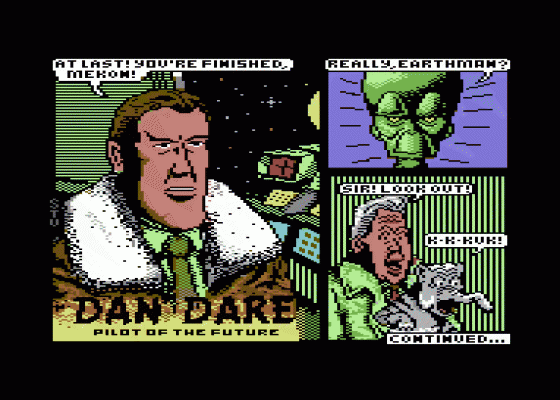
In 1986, twenty one years before Virgin Comics launched their seven part series of Dan Dare comics by Garth Ennis and Gary Erskine, Virgin Games created a Dan Dare: Pilot of the Future video game for the ZX Spectrum, Amstrad CPC and Commodore 64 home computer systems, with the Commodore 64 version being significantly different in gameplay from the other two, although based on the same premise. Virgin's interest in Dan Dare comes from the company's founder Richard Branson, who was an EAGLE reader in his boyhood and is a keen Dan Dare fan. In the game, the Mekon threatens to destroy the Earth with a huge hollowed out asteroid unless our leaders submit to his terms. Dan and Digby journey to the asteroid in Anastasia and realise it is inhabited when they see artificially built structures there. Dan enters the asteroid to fight the Mekon and his Treen followers and to face a number of tasks. In the Spectrum and Amstrad versions he is armed with a laser gun and has to pass through levels collecting five pieces of an explosive device, with each piece enabling him to move on to the next. Dangers include armed Treens and floor and wall guns. If he is shot, Dan loses energy and if that reaches zero, he is captured and put in a cell. Although he then escapes, the cell is some distance from the key parts of the complex and this causes a time loss. If Dan runs out of time before he can assemble the five parts, then the Mekon wins.

Dan is unarmed in the Commodore 64 version. He has to combat his Treen assailants with his fists. Accompanied by Stripey, Digby's pet, he must first travel through the asteroid's surface and subterranean lakes, solving various puzzles and collecting items that will allow him to enter the Mekon's base. Here he must fight Treen guards and free a captured Digby and Professor Peabody before destroying three computers with a giant laser. Finally he fights the Mekon in a grenade battle and on defeating him, he has two minutes to return to his ship, the Anastasia before the base explodes. This version of the game takes place in half an hour of real time.  

Both versions of the game proved highly popular and were praised for their graphics and the challenges they posed for players. In 1986, Dan Dare's adventures were appearing weekly in the new version of EAGLE, although their hero was the great great grandson of the original, so the character was familiar to young gamers. The success of the game, which reached number two in the U.K. sales chart spawned two sequels, Dan Dare II - The Mekon's Revenge and Dan Dare III - The Escape, but these were not as well received, with reviewers widely considering them to be no improvement on the original.         


Monday, 11 April 2022

EAGLE TIMES VOL.35 No.1

The first EAGLE Times of the new year is out now and now is the best time to subscribe for the four issues of 2022. The subscription remains at £30 and should be sent to Bob Corn at the address on the right. In this issue are articles about the back page strip The Great Explorer (David Livingstone), the Riders of the Range adventure Last of the Fighting Cheyenne, a Frank Hampson Studio feature about the Dan Dare story Rogue Planet, a look at the life of Roy Romaine, who was featured as one of EAGLE's Sporting Heroes, a short article about the EAGLE Club album Famous Men of Today and a feature about the Canadian Pacific Railway. Our former editor Will Grenham also reports on an interesting discovery of a short story published in EAGLE in 1950, which proved to be copied by its 'author' almost word for word from a story by Captain W.E. Johns. Finally there is part one of Steve Winders' new Archie Willoughby story, The Case of the Coveted Coffin, which isn't copied from anyone!   

Wednesday, 23 March 2022

IN AND OUT OF THE EAGLE 29


Only a small number of artists and a single writer worked on both the original EAGLE and the 1980s revival. This was principally because of the thirteen year gap between the end of the original and the start of the new version. The writer was Tom Tully, who wrote Heros the Spartan for the original between 1962 and 1966 and some Guinea Pig stories. He   wrote Thunderbolt and Smokey, Robo Machines, The Avenger, the later adventures of Dan Dare's great great grandson and subsequently the adventures of the original Dan for the 1980s EAGLE.

The work of three of the artists was featured in the very first edition of the 1980s version, despite the fact that there were only two illustrated strips and one that was partly illustrated as the others were photo strips. Gerry Embleton illustrated the Dan Dare strip, having illustrated a few episodes of the Riders of the Range adventure Last of the Fighting Cheyenne in the original in 1961. He also illustrated a four page strip about the Royal Canadian Mounted Police called The Royal Riders for the EAGLE Annual 1963. The second artist whose work appeared in the first issue was Jose Ortiz, who drew The Tower King. He had illustrated most of the U.F.O. Agent / Smokeman saga for the original EAGLE from 1966 - 1968 and then Sky Buccaneers, the strip which replaced it. For the 1980s EAGLE he also drew The House of Daemon, The Fifth Horseman, News Team, The Thirteenth Floor (initially in Scream but then for 130 episodes in EAGLE), Survival, Kid Cops and Kitten Magee (initially in Wildcat but then in EAGLE). The final artist was the veteran Ron Smith who drew part of The Collector, a photo strip which included some illustrated aliens! These were drawn by Smith, who later drew MASK and Wildcat for those comics which were subsequently absorbed into EAGLE and he continued to draw some of those strips for EAGLE. He also drew a single page feature Max's Fly Game for the EAGLE Annual 1987. His contribution to the original EAGLE was a series of half page strips about Sporting Personalities which appeared right back in 1950! He signed his work on this strip as 'Ross' and I am grateful to Richard Sheaf and David Slinn, who identified him as artist.

The prolific artist John M. Burns illustrated Wrath of the Gods for Boys' World and then for its final six episodes in the original EAGLE when the two papers combined. He also drew a few non fiction strips for the original, including several instalments of Bids for Freedom. For the 1980s EAGLE he drew The Fists of Danny Pike, Dolebusters and a single Dan Dare adventure. Luis Bermejo, who illustrated a Mann of Battle story in 1962 and several Heros the Spartan adventures between 1963 and 1966 for the original EAGLE, alternating with Frank Bellamy before taking over the strip, also drew two episodes of U.F.O. Agent in 1966. He later took over the News Team strip from Jose Ortiz after the first seven episodes, in the 1980s EAGLE. With Vicente Alcazar, Carlos Pino illustrated the final Guinea Pig story in EAGLE in 1969. Later he drew the second series of Bloodfang for the 1980s EAGLE and also some MASK strips, when EAGLE absorbed the MASK comic. 

Although he did not contribute to the original EAGLE weekly, Wilf Hardy drew covers for The EAGLE Book of Modern Wonders, published in 1958 and The EAGLE Book of Cars and Motor Sport, published in 1963, before illustrating Data Files, which were the equivalent of the old Cutaway Drawings in the early issues of the 1980s weekly. Jim Baikie drew the Dan Dare strip in the 1974 EAGLE Annual and illustrated the first series of Bloodfang which ran from issue 116 to 127 in the 1980s EAGLE.

When the original Dan Dare was revived for the 1980s EAGLE in 1989, Keith Watson, one of the original Dare artists from the 1950s and 60s EAGLE was employed to bring him back. He drew two full adventures and the first episode of a third. He had been employed as a member of Frank Hampson's team producing the Dan Dare strip from the mid fifties, before taking over the strip himself from 1962 until 1967. Another member of Frank Hampson's team, Don Harley, who joined in 1951, remained with the strip to assist Frank Bellamy when Hampson left in 1959 and took over the strip himself a year later, working with Bruce Cornwell until 1962. Although he did not produce any artwork for the 1980s EAGLE weekly, he illustrated a Dan Dare strip for the 1991 Dan Dare Annual. 

Finally, Ian Kennedy, who illustrated the Dan Dare strip in the 1980s EAGLE from 1982 - 1985 and later drew MASK and Wildcat strips when those comics were absorbed by EAGLE in 1988 and 1989 respectively, did not work on the original EAGLE weekly, but produced 'drop in' pictures for a text feature Quick on the Draw' for EAGLE Annual Number 5, produced in 1955. He was credited as Charles I. Kennedy for this work.  

Sunday, 20 March 2022

THE 1980S EAGLE IS 40


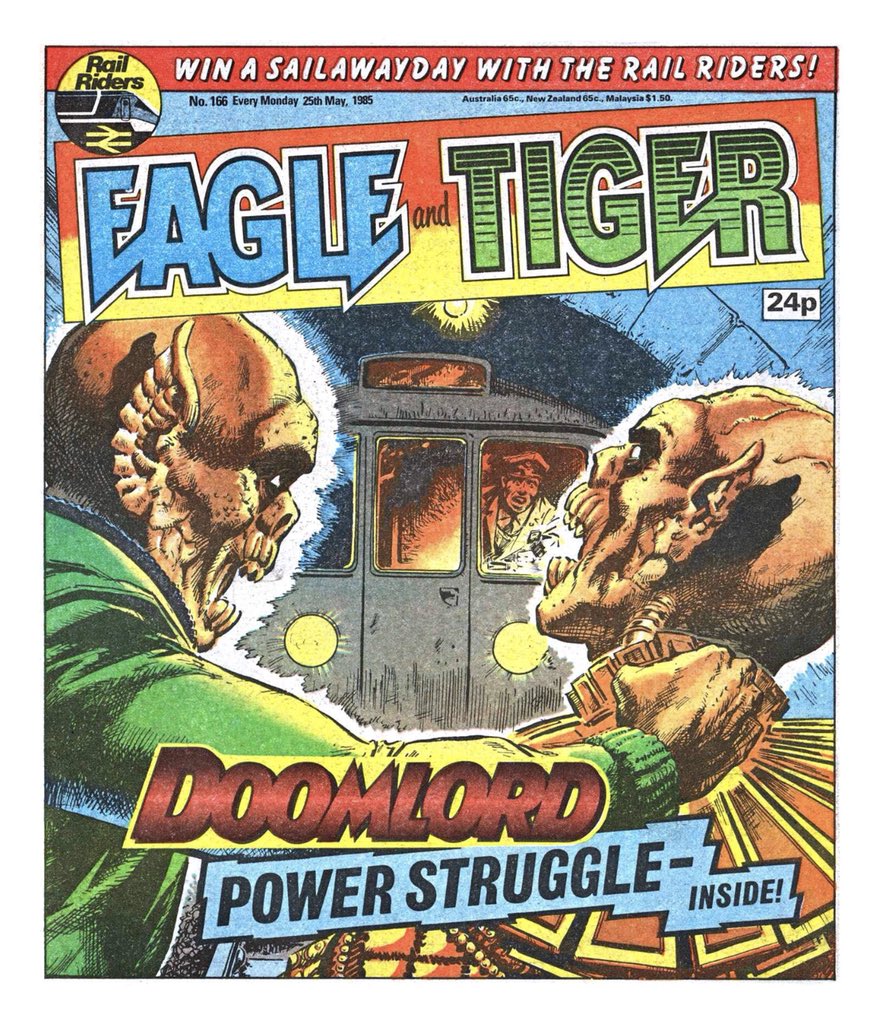
Today is the fortieth anniversary of the 1980s EAGLE, which was launched on March 20th 1982. Featuring the adventures of Dan Dare's great great grandson in strips illustrated by Gerry Embleton, Oliver Frey, Ian Kennedy, Carlos Cruz, John Gillatt and Manuel Carmona, it also included several photo strips in its first year, notably Doomlord, about an alien sent to judge humanity's right to exist. Unfortunately he judges us unfit, but is killed in an act of self sacrifice by the hero. A later Doomlord judges humanity favourably and becomes mankind's protector. Other strips included Sergeant Streetwise,about an undercover police officer and Manix, about an android working for British Intelligence. In a mostly successful effort to capture the spirit of the original EAGLE, it ran several features, such as a sports page and cutaway drawings of planes, tanks and other vehicles. From issue 79 the photo strips were wholly replaced by illustrated ones, with Doomlord, illustrated by Heinzl and then Eric Bradbury, continuing to be popular with readers. A later popular strip was Computer Warrior, in which a young boy was absorbed into his computer and forced to play computer games for real. Over the years EAGLE featured a wide range of strips. It ran school based stories, war stories, supernatural stories, sports based stories, superhero stories and even a western 

EAGLE ran until 1994, absorbing several other comics during its life. It absorbed Scream in 1984, Tiger in 1985, Battle in 1988, Mask in 1988 and Wildcat in 1989. 

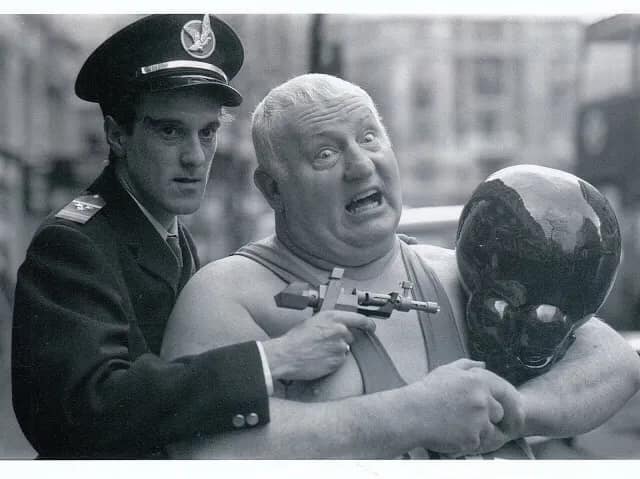
(The picture above shows artists' agent Tony Kelleher as Dan Dare and the wrestler 'Big Daddy' with Pip Warwick's ceramic sculpture of the Mekon at the press launch of the 1980s EAGLE at the Waldorf Hotel on March 17th 1982)


In 1989 Dan Dare's great great grandson's adventures were replaced with new stories of the original Dan. Keith Watson, who had illustrated the strip in the original EAGLE, drew two stories and part of a third, which was completed by Andrew Skilleter. Keith Page, John Ridgway and John M. Burns also illustrated new Dan Dare strips before David Pugh took over as artist, with some stories drawn by Jon Haward.

By the late 1980s, the heyday of British comics was well and truly over, as young readers embraced computer games. The number of other comics that were merged into EAGLE reflects this decline. In May 1991 EAGLE changed from weekly to monthly and apart from new adventures of Dan Dare and Computer Warrior, was mainly filled with repeats of popular strips. These included Charley's War, the celebrated First World War strip which had come from Battle weekly when it merged with EAGLE. Finally in January 1994, EAGLE's last issue appeared and the decline in sales of comics is made clear by the fact that there was no similar publication for it to merge into. Apart from 2000 A.D. which by then was aimed at a much older audience, EAGLE was the last survivor.

Writers who worked on the 1980s version included Pat Mills, John Wagner, Tom Tully, Alan Grant, Alan Hebden, Fred Baker, Scott Goodall, Gerry Finley-Day and Barrie Tomlinson. Contributing artists not mentioned earlier included Rex Archer, Mike Western, Robin Smith, Sandy James, John Cooper, Carlos Ezquerra, Jose Ortiz, Luis Bermejo, Mike Dorey and Mike White. The 1980s EAGLE is fondly remembered today by its readership and celebrated by several Facebook groups and a regular podcast called Where EAGLES Dare, run by Dave Ronayne and Pete Adamson. There was also an excellent fanzine, EAGLE Flies Again produced by Ian Wheeler in the early years of this century.

Thursday, 3 March 2022

IN AND OUT OF THE EAGLE 28


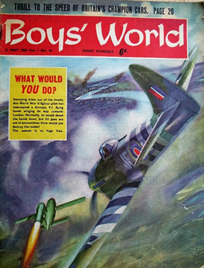
When EAGLE was absorbed into Lion in 1969, Dan Dare was joined by three other strips from EAGLE in the combined comic. These three were all recent arrivals in EAGLE, specially created for the merger. However, the front cover featured What Would You Do? which had also run on the front page of Boys' World,  the paper that EAGLE itself had taken over in 1964. The pictures were redrawn for Lion and the text was reduced and simplified, but they were exactly the same problems for readers to solve that had featured in Boys' World.  

As EAGLE's companion paper, Boys' World featured the work of many artists and writers who contributed to EAGLE. Artists included Frank Bellamy, Harry Lindfield, George Bowe, Roy Cross, Frank Humphris, Ron and Gerry Embleton, Eric Kincaid, Roland Fiddy, Reg Parlett, Luis Bermejo, Colin Andrew, Alexander Oliphant, Gerry Haylock and Brian Lewis. Martin Salvador, Bill Mainwaring and John M. Burns crossed over to EAGLE with The Iron Man, Billy Binns and Wrath of the Gods respectively, when the papers merged in October 1964.  

Writers who worked on both included Tom Tully, Ken Mennell, Edward Cowan, David Motton and Willie Paterson and the papers were both edited by Bob Bartholomew. There is evidence that the EAGLE and Boys' World merger was hurried and therefore enforced from above by the controlling Mirror Group. Nearly all the strips were in mid story when the merger took place and the combined paper briefly included eight colour pages to accommodate the already coloured Wrath of the Gods. The sixties EAGLE and Boys' World had both carried six colour pages and when Wrath of the Gods ended in EAGLE six episodes later, this situation was resumed.

IN AND OUT OF THE EAGLE 27

In his autobiography Comic Book Hero, Barrie Tomlinson, the former Group Editor of Fleetway’s Boys’ Sports and Adventure Comics, who launched the 1980s EAGLE, describes starkly the attitudes of senior management to their publications in an anecdote about his apointment as editor of Tiger, earlier in his career: “I was the eager, enthusiastic new editor of Tiger comic. I had worked out lots of new ideas for the title. I rushed into the office of the managing editor and listed my plans for Tiger. A few minutes later, I left the office somewhat deflated, having been told ‘It’s only a comic!’”

Inspired by the example of the original EAGLE that he had read as a boy, Barrie established a Tiger Sports Star of the Year Award and signed famous sports stars to write for the paper. He also began to sign the editor’s letter to establish a real link with readers, as Marcus Morris had done in EAGLE, a practice prevously unknown in Fleetway’s comics.

When EAGLE was relaunched in 1982, Barrie again signed up famous names to write for it, as the original had done These included the athlete Daley Thompson and the disc jockey Mike Read. He also followed the original in introducing reader participation features. A popular one was the Glamorous Teacher feature, which would no doubt be considered sexist today! There was also Superdad, where readers would write about their special dads and Big Mouth,a chance for readers to sound off about issues that concerned them.